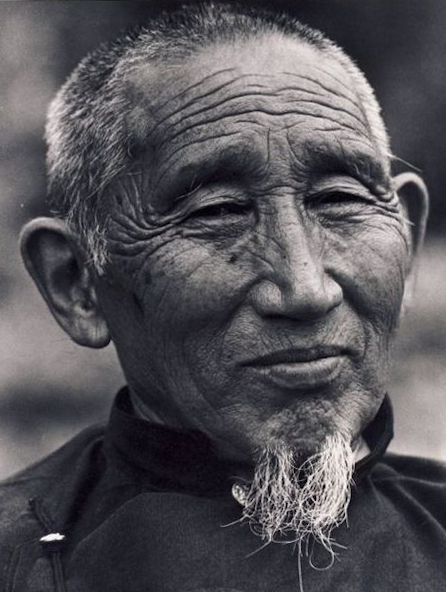
Geshe Ngawang Wangyal (1901-1983), a groundbreaking Kalmyk-Mongolian Buddhist scholar and monk, holds a unique place in the history of Tibetan Buddhism in the West. Born in the Astrakhan Governorate of Russia (now part of Kalmykia), he received his early monastic education in Kalmyk khuruls before traveling to Tibet in 1922, where he studied at Drepung Gomang Monastery and earned his geshe lharampa degree - the highest academic honor in Gelug Tibetan Buddhism. After earning his degree and fleeing Soviet persecution in Kalmykia, he arrived in the United States in February 1955 as part of a group of Kalmyk refugees resettled in Freewood Acres (now part of Howell Township), New Jersey. The Kalmyk community had already established their first temple, Rashi Gempil-Ling ("Sanctuary for the Increase of Auspiciousness and Virtue"), the first Kalmyk and Tibetan Buddhist temple in the Western Hemisphere.
Upon arrival, Geshe Wangyal sought to affiliate with the local Kalmyk Buddhist sangha and primarily associated with Rashi Gempil-Ling, where he contributed as a spiritual leader and teacher in the early years. As the highest-qualified scholar (with training in Kalmykia and Tibet), he supported rituals, teachings, and the preservation of Gelugpa traditions among the resettled Kalmyks.
Recognizing the need to transmit authentic Tibetan Buddhist teachings more broadly - especially to Western students interested in scholarly study and practice - Geshe Wangyal founded an independent center in 1958: the Lamaist Buddhist Monastery of America (LBMA), initially in Freewood Acres. This became the first dedicated Tibetan Buddhist dharma center in the West focused on rigorous academic and meditative training. In the late 1960s, he relocated it to Washington, New Jersey, renaming it Labsum Shedrub Ling (Tibetan Buddhist Learning Center), where it continues today. He trained pioneering American scholars like Robert Thurman and Jeffrey Hopkins, hosted His Holiness the 14th Dalai Lama during his landmark 1979 U.S. visit (which Geshe Wangyal helped facilitate), and advanced the intellectual credibility of Tibetan Buddhism in academia and beyond.
Shortly after his arrival in the U.S., around 1956-1957, Geshe Wangyal was recruited by the Central Intelligence Agency (CIA) with the assistance of Thubten Jigme Norbu (Takster Rinpoche, 1922-2008), the eldest brother of His Holiness the 14th Dalai Lama. Norbu, who had emigrated to the U.S. under CIA sponsorship in October 1957, had known Geshe Wangyal from their earlier time in Lhasa. As the only qualified Tibetan scholar in the U.S. at the time, Geshe Wangyal was an ideal candidate for the agency's needs amid the escalating Cold War and Chinese occupation of Tibet. His recruitment was part of the CIA's covert Tibet program, code-named ST Circus (also referred to as the Tibet Task Force), aimed at supporting Tibetan resistance against communist expansion.
Geshe Wangyal's primary contribution to the CIA was developing a specialized Tibetan telecode - a dictionary and encoding system that adapted the Tibetan script for secure Morse code transmission over radio. This innovative tool enabled reliable, encrypted communications between CIA-trained Tibetan guerrillas (including radio operators parachuted into Tibet) and their U.S. handlers. The telecode was crucial for coordinating operations, transmitting intelligence, and maintaining contact with resistance networks in remote Tibetan regions.
This system played a direct and pivotal role in the Dalai Lama's dramatic escape from Tibet in March 1959. Amid rising tensions in Lhasa following the Tibetan uprising on March 10, the 14th Dalai Lama fled his summer palace (Norbulingka) disguised as a soldier, accompanied by a small entourage. CIA-trained Tibetan radio operators joined the escape party and used Geshe Wangyal's telecode to send Morse code messages detailing the group's progress, coordinates, and status. In a suburban house outside Washington, D.C., Geshe Wangyal himself worked alongside CIA officer John Greaney, monitoring the wireless receiver and translating incoming Morse code transmissions from Tibetan into English using the special dictionary he had created. This allowed the CIA - and indirectly U.S. policymakers - to track the escape almost in real time, long before the world press knew of the Dalai Lama's fate. The guerrillas also employed the telecode to request political asylum from Indian Prime Minister Jawaharlal Nehru on behalf of the Dalai Lama, his cabinet, and family, facilitating their safe crossing into India on March 31, 1959. Without this secure communication capability, the escape might have faced greater risks from pursuing Chinese forces.
Geshe Wangyal continued his CIA contract work through 1960, after which he stepped away as the Tibet program evolved (it continued until the early 1970s under shifting U.S.-China relations). His involvement remained classified for decades, separate from his public spiritual activities.
Geshe Wangyal trained a remarkable group of Western students who became foundational figures in the academic and cultural transmission of Tibetan Buddhism in America. Among his most famous students were:
- Robert A. F. Thurman, Professor Emeritus of Indo-Tibetan Buddhist Studies at Columbia University, president and co-founder of Tibet House US, and author of numerous books on Tibetan Buddhism. Thurman was one of Geshe Wangyal's earliest resident students in the early 1960s, became the first American ordained as a Tibetan Buddhist monk (in 1964 by the Dalai Lama, whom Geshe Wangyal introduced him to), and later earned his PhD in Buddhist Studies. He credits Geshe Wangyal as his first guru and a life-saving influence.
- Jeffrey Hopkins, Professor Emeritus at the University of Virginia and a prolific translator of Tibetan Buddhist texts. Hopkins studied intensively under Geshe Wangyal starting in the early 1960s, contributing to the center's development while learning Tibetan and Buddhist philosophy. He went on to establish pioneering programs in Tibetan studies and served as the Dalai Lama's chief English translator for many years.
- Joshua and Diana Cutler, long-time directors of the Tibetan Buddhist Learning Center (Labsum Shedrub Ling), who began studying with Geshe Wangyal in the early 1970s. They oversaw major translation projects, including Tsongkhapa's Great Treatise on the Stages of the Path to Enlightenment.
- Other notable students included scholar and translator Alexander Berzin (founder of Study Buddhism), Anne C. Klein (Professor at Rice University and co-founder of Dawn Mountain Center), composer Philip Glass, painter Ted Seth Jacobs, and scholars like Leonard Zwilling, Michael J. Sweet, and Daniel P. Brown.
These students, often in exchange for teaching English to Tibetan monks sponsored by Geshe Wangyal, formed the first generation of Western Tibetan Buddhist scholars and practitioners. Geshe Wangyal's emphasis on rigorous textual study, language proficiency, and philosophical foundations helped establish Tibetan Buddhist studies as a serious academic field in the U.S., making him widely regarded as the "grandfather" of the discipline.
For the Kalmyk community, Geshe Wangyal represents resilience: bridging refugee hardships, Cold War geopolitics, and the global spread of the Dharma. His legacy endures through Labsum Shedrub Ling, which carries forward his vision of study and practice, while Rashi Gempil-Ling remains active in Howell, NJ, preserving Kalmyk traditions.