


Recent Posts
Rare 1947 Kalmyk Children's Primer from 1947: "Халъмак бичик - Брос узгул"
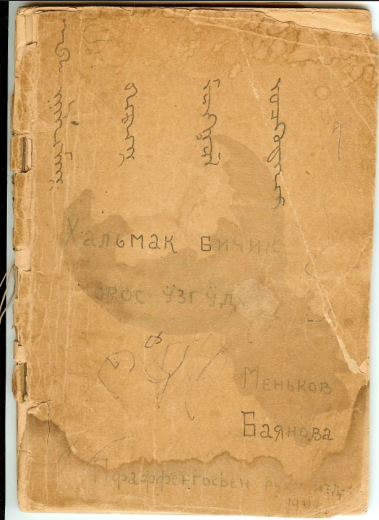
One of the most precious surviving artifacts of Kalmyk exile education has surfaced: a hand-duplicated children’s primer titled **Халъмак бичик** (Kalmyk Book) and **Брос узгул** (First Reader / Alphabet Learning). Produced in 1947 in a German Displaced Persons (DP) camp and based on a 1940 manuscript, this 27-page booklet was compiled by Menkov, Bayanova and others and marked "Als Manuskript vervielfältigt" (reproduced as manuscript). Priced at 5 RM, it was created specifically for Kalmyk children living in the uncertainty of post-World War II camps in Germany.
Download The 1947 Primer From Kalmyks.com
After the war, thousands of Kalmyks found themselves in DP camps across Germany. Many had fled Soviet repression or had been displaced during the conflict. In these camps they quickly organized schools, temples and cultural activities to keep their language and identity alive. This little primer is a direct product of that determination - a lovingly handmade textbook that taught reading, writing, arithmetic, calendar knowledge and Buddhist values using the traditional Clear Script (Todo Bichig), with Cyrillic and phonetic support for the new generation born in exile.
The book is richly illustrated with hand-drawn pictures on almost every page: apples, horses, cows, yurts, traditional clothing, musical instruments, beds, keys, bows, nests, clouds, and everyday objects. These drawings turn each lesson into a visual vocabulary builder. The style is warm and child-friendly, clearly made with love by people who knew their culture might not survive without such efforts.
Here are translations and summaries of some of the most meaningful pages:
Page 5 - Buddhist Refuge Prayer (one of the earliest Kalmyk children’s prayers preserved from the DP period)
The text is a beautiful Kalmyk adaptation of the Three Jewels refuge formula:
"Лоёр көлү нугудын дэл Бурхнд иткмү
Лама орчланг кигял,
Му заятын аюл эц,
Ёвякин Бакш болн сөрхүн.
Тачаңы эц хакцкын
Нугудын дэл Нопд иткмү
Лама орчланг кигял
Му заятын аюл эц,
Ёвякин бүдн болн сөрхтн.
Цулын нугудын дэл,
Хорвокт иткмү
Лама орчланг кигял,
Му заятын аюл эц,
Ёвякин хань нөкөл,
Болн сөрхтн."
Translation:
"I take refuge in the Buddha, the Teacher of the world,
who frees us from the dangers of bad rebirths,
the precious Guru and protector.
I take refuge in the Dharma, the precious Teaching,
who frees us from the dangers of bad rebirths,
the precious Sangha and protector.
I take refuge in the Sangha, the community of noble ones,
who frees us from the dangers of bad rebirths,
the precious friends and protectors."
This prayer taught even the youngest children the core of Gelug Buddhist faith while they were far from their homeland.
Pages 3-4, 6-7, 9, 12 - Alphabet and Vocabulary Lessons
Letters are introduced with charming drawings:
- "A a" - apple
- "M m" - horse ("Ma-ma Ma", "Am-am Au")
- "U u" - bucket, nest, bottle
- "K k" - traditional Kalmyk clothing and hats
Simple words and phrases accompany each picture so children could connect written Kalmyk with everyday life.
Pages 8, 10-11, 20-21 - Arithmetic
Basic addition and subtraction tables are presented clearly, with examples such as: 1-1=0, 2-1=1 … up to 10-1=9 and more complex sums. These were essential skills for children whose families were rebuilding their lives from nothing.
Page 10 - Calendar and Zodiac
A beautiful double-page spread lists the 12 months and the 12 animal signs in Kalmyk (Тула / Rabbit, Лу / Dragon, Мога / Snake, Мөрн / Horse, etc.) alongside the Gregorian calendar - helping children navigate both their traditional lunar calendar and the Western one they encountered in Europe.
Later pages - Short texts and cultural content
Simple sentences about yurts ("Хальмак герь айта" - The Kalmyk yurt is beautiful), family life, nature, and daily objects. One page even shows a traditional Kalmyk woman in national dress.
This modest 27-page booklet is far more than a schoolbook. It is living proof of Kalmyk resilience: in the ruins of post-war Europe, our grandparents and great-grandparents refused to let the language, script, faith and culture die. Every drawing, every prayer, every letter was an act of cultural survival.
Today, thanks to this surviving copy, we can see exactly how our people taught their children in the DP camps of 1947. It stands as a powerful reminder that no matter where Kalmyks have been scattered - Germany, America, Australia, or back in Kalmykia - the flame of our language and heritage has never been extinguished.
If you have family stories from the German DP camps or other early Kalmyk primers, please share them with us at Kalmyks.com. These fragile books are part of our living history.
Сар шүүдэр мөргөе!
Хальмак келн мандан үлзг!
The front cover credits the original 1940 primer to:
Меньков (Menkov)
Баянова (Bayanova)
Reproduced or printed this edition by Sandscha Zagadinow in 1947.
In the DP camps, someone had to organize the mimeographing or hand-duplication of books. Sandscha Zagadinow took on that role for this little primer - he is the producer/publisher of the 1947 camp edition.
Posted on March 22, 2026 at 12:52 PM by Kalmyks.com
Type: Kalmyk Culture
1970 Illustrative Book on Kalmyk Folk Art
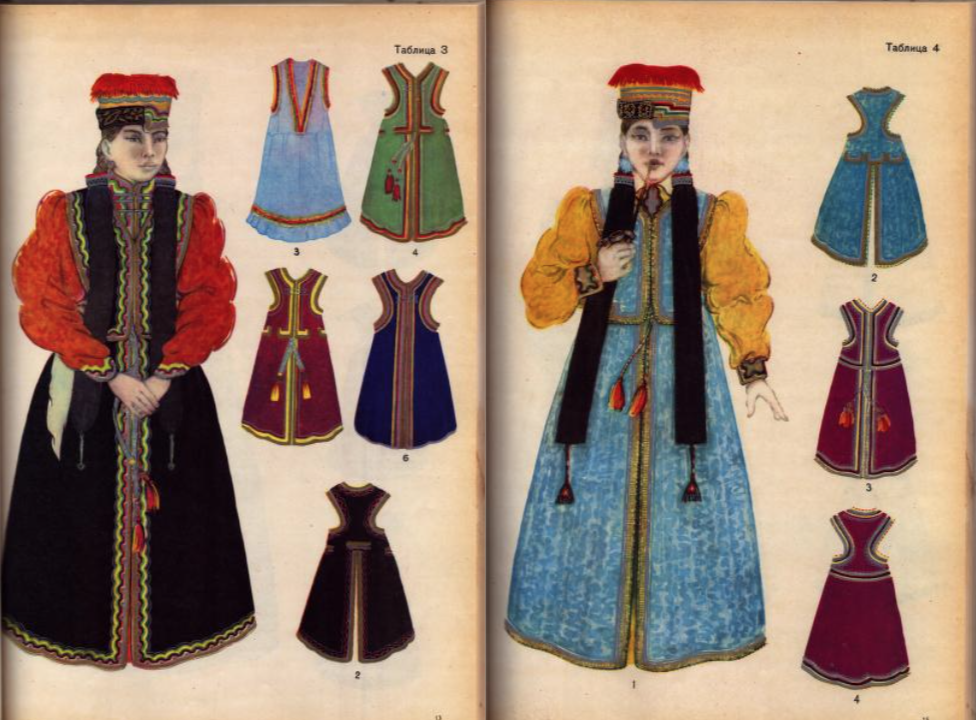
Screenshot as it appeared on 3/22/2026, archived at https://archive.org/details/kalmyk-folk-art-1970
Yandex Book Link: https://disk.yandex.com/i/HDJJ5sDBfu6tQA
Internet Archive Book Link: https://archive.org/details/kalmyk-folk-art-1970
The cultural archive account TheEasternArchive shared the addition of a rare illustrative book titled "Kalmyk Folk Art" originally published in 1970, to its online collection.
The volume contains numerous detailed illustrations showcasing traditional Kalmyk folk costumes and artistic motifs, preserving visual records of the cultural heritage of the Kalmyk people, also known as Oirats. These nomadic Mongolic descendants, primarily residing in the Republic of Kalmykia with its capital in Elista, Russia, maintain a distinct identity rooted in Tibetan Buddhism and steppe traditions.
This update brings renewed attention to Kalmyk material culture through accessible digital sharing, highlighting ongoing efforts to document and celebrate the unique artistic expressions of Europe's only Buddhist-majority ethnic group.
- [1] X post by @TheEastArchive announcing the book addition
- [2] TheEasternArchive Blog Post on Kalmyk Folk Art
Posted on March 22, 2026 at 08:19 AM by Kalmyks.com
Type: Article
Kalmyk-American Diaspora Gathers celebrating Tsagaan Sar and to Mark 75th Anniversary of Refugee Arrival
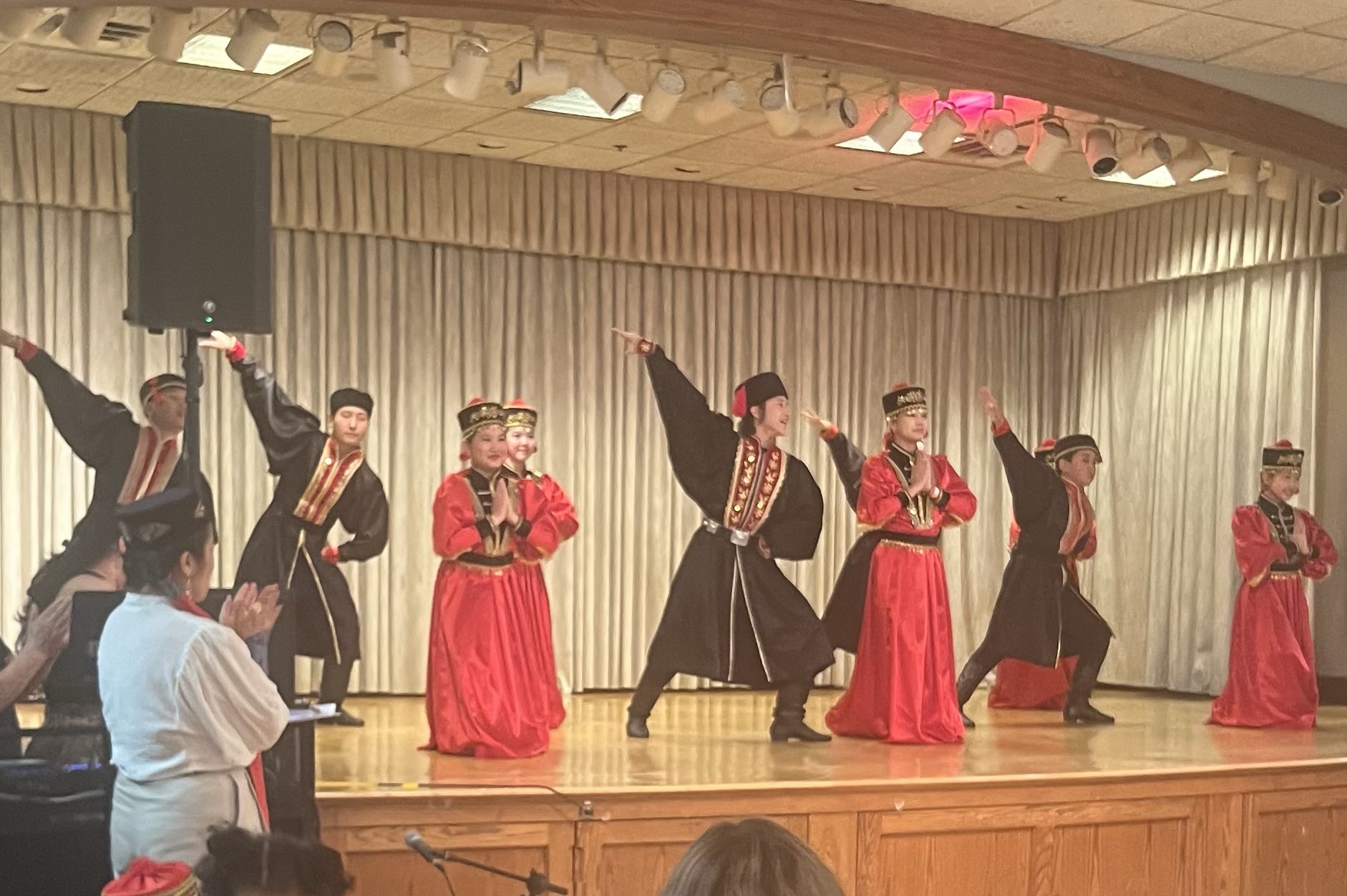 Source: X post by Sasha Stiles (fair use)
On March 15, 2026, members of the Kalmyk community in the United States, held a commemorative evening celebrating Tsagaan Sar (year of the Fire Horse) and the first event of the 75th anniversary of the first wave of Kalmyk refugees arriving from displaced persons camps in Germany after World War II. Several other events planned for Summer and Fall this 2026.
- Tsagaan Dance - March 14, 2026 the first event celebrating 75 years of Kalmyks in the US
- X Post by @sashastiles
- 2026 Tsagaan Dance, kicking off the 75th Anniversary of Kalmyks in the United States
Posted on March 16, 2026 at 03:43 PM by Kalmyks.com
Type: Article
Kalmyk Wrestler Dordji Shungurtsikov Claims Silver at U-23 European Championship
Dordji Shungurtsikov from Kalmykia secured the silver medal in Greco-Roman wrestling at the U-23 European Championship held in Serbia on 14 March 2026.
He had advanced to the final earlier the same day, spotlighting athletic talent from the republic.
Posted on March 16, 2026 at 02:23 PM by Kalmyks.com
Type: Kalmyk Culture
Khal'mag uzgel by Danara Bajanov
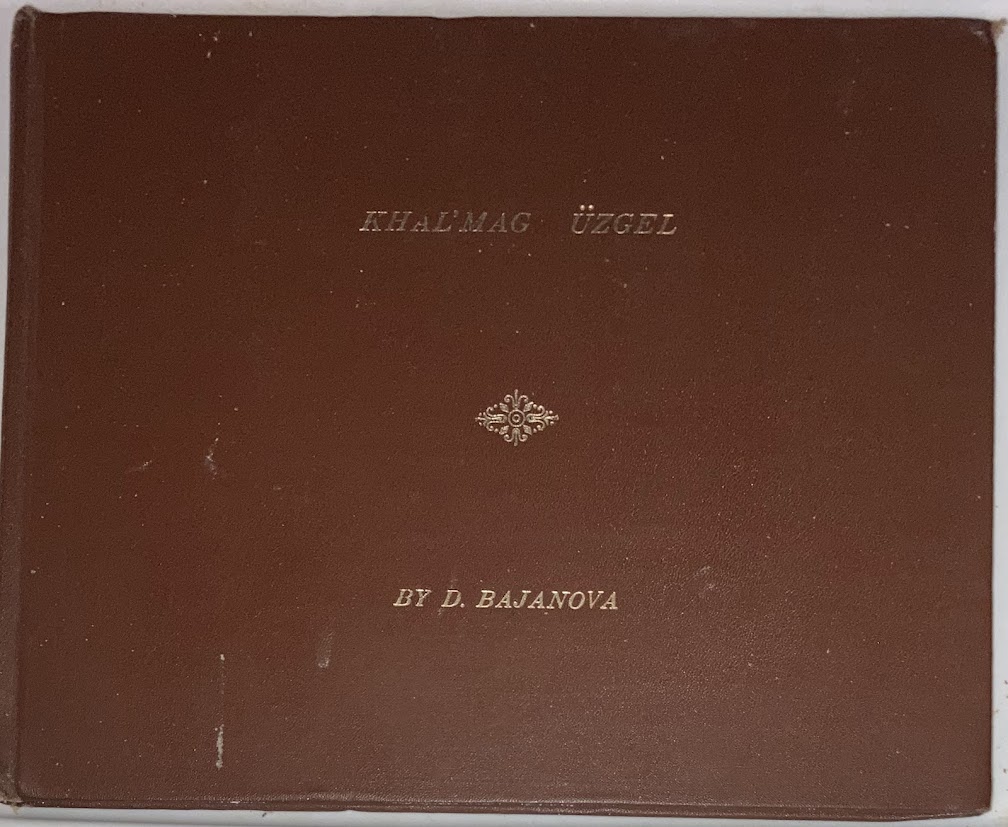
"Khal'mag uzgel" translates to "Kalmyk script" or "Kalmyk letters." It is the title of a Kalmyk-language primer or alphabet book (букварь in Russian), focused on teaching the Todo Bichig (Clear Script), the traditional vertical Mongolian-derived script adapted specifically for the Kalmyk (Oirat) language in the 17th century by Zaya Pandita. From scholarly references in Kalmyk studies and publications by the Kalmyk Institute for Humanities of the Russian Academy of Sciences (КИГИ РАН), this book was authored by Danara Bajanov and was created as a teaching tool for the Kalmyk diaspora and taught in Howell, NJ.
Key Context and History
-
Publication and Purpose:
The book was used in Howell, New Jersey in order to teach kids Kalmyk language. Literacy in Todo Bichig had declined under Soviet Cyrillic reforms (introduced in the 1920s-1930s for Kalmyk), so primers like this preserved cultural identity, language, and script among exiles. -
Content and Style:
As a букварь (primer), it likely includes: Todo Bichig alphabet with letter forms, pronunciations, and basic combinations. Simple exercises, words, and short texts (e.g., everyday vocabulary, perhaps cultural or folk elements like animals, yurts, horses-mirroring the doodles you've shared: morin/horse repeats, ger/yurt, tools). Illustrations or simple drawings to aid learning, especially for children or adults relearning the script. Pages-with repeated "morin" practice strokes, labeled objects (knife, shovel, axe, pendant, morin khuur fiddle), mixed Cyrillic notes ("Ами Мама"), and folk-art style-align perfectly with a learner's workbook or annotated primer. The vertical script practice, doodles of steppe life (horses, ger, dance, lamb), and baby-talk Cyrillic feel like a child's or beginner's exercises in such a book. -
Cultural Significance:
In the Kalmyk diaspora community in Howell, books like this were vital for transmitting heritage. Todo Bichig symbolizes pre-Soviet identity and Oirat-Mongol roots, distinct from Khalkha Mongolian. -
Nuances and Related Considerations:
Authorship Details: Danara Bajanov is referenced in works on Kalmyk émigré printing and education collaborating on script-teaching materials during the DP era. Script Specifics: Todo Bichig (Clear Script) was designed to better represent Oirat vowels/consonants than classical Mongolian script. The books doodles show classic features: tall "m" curls for morin (ᡏᡅᠷᡅᠨ), stacked columns, vowel diacritics as hooks/dots. Today, Todo Bichig is taught optionally in Kalmykia schools and online (e.g., via Kalmyk cultural sites). Books like this are collectible heritage items versions sometimes circulate in academic archives or diaspora groups. The book that was the source for these images appear to have been used, so the book may not be in it's original form.
Posted on March 14, 2026 at 10:26 AM by Kalmyks.com
Type: Kalmyk Culture
Discovering Kalmyk Musical Heritage: The Gordon Bok Collection
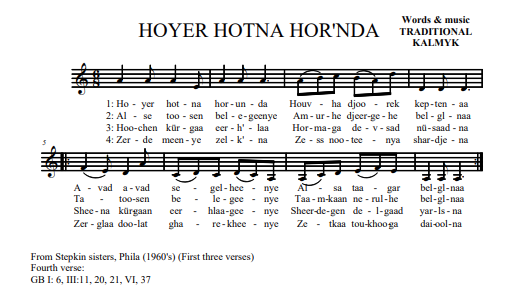
For the Kalmyk community worldwide, preserving our language, songs, epics, and traditions is a matter of cultural survival. One remarkable resource that has helped keep Kalmyk folk music alive - especially among the American diaspora - is the **Kalmyk Music Collection** curated by American folk musician Gordon Bok. Available online at https://gordonbok.com/kalmyk-music, this open-access archive offers a treasure trove of recordings, a songbook, and historical context that honors the resilience of Kalmyk immigrants who brought their heritage to the United States in the 1950s.
Gordon Bok, a renowned folk singer, songwriter, and maritime music specialist from Maine, first encountered Kalmyk music in the 1960s while working winters in Philadelphia. There, he befriended Kalmyk immigrants, sang with them, joined their small orchestra for dance events, and received personal recordings of songs and tunes. Over decades, Bok preserved these materials: amateur tapes from the 1960s-1970s, cleaned versions in 2003 by the Maine Folklife Center, and additional recordings he made into the 2000s during visits to the Philadelphia/New Jersey area. In 2011, he received a Lifetime Achievement Award at the New Jersey Folk Festival for his dedication to collecting and safeguarding Kalmyk folk music.
The heart of the collection consists of twelve compact discs (with track lists available on the site) containing music and spoken words from Kalmyk immigrants in New Jersey and Philadelphia. These include amateur home recordings, some featuring long songs in Derbet dialect, dance tunes, and newer songs popular among Bok's generation of friends. The archive also houses a downloadable PDF songbook, "Kalmyk Music: A Songbook," with phonetic transcriptions, simple melodic sketches (not full notations), and example audio tracks. Bok emphasizes that the sketches are guides only: "The tunes are not written down as they were sung. They are a melodic sketch and you must go to the originals in the collection to sing them as they were really sung."
The site includes Virginia Houpt's 1983 essay "Kalmyk Music: The Celebration of an Immigrant Culture," which explores how Kalmyk songs reflect centuries of migration and adaptation. Houpt writes: "One must respect the Kalmyks, for their culture is their home." Bok echoes this sentiment: "For 400 years, without a homeland, Kalmyks have kept their language, legends, epic songs and religion alive: that’s an amazing achievement. This is great, powerful music, unique in the world." He stresses the music's wandering nature - influenced by Russia, Mongolia, and other lands - and encourages freedom in performance: "There is NO right or wrong way to do this music. The only way you can hurt it is not to sing it."
Key contributors highlighted include Nadja Stepkin Budschalow (who kept many songs alive and taught them), Gawril and Allison Budschalow, Alex and Sara Goripow, Lidia and Gerel Buruschkin, Ginger Hildebrand, and others from the Philadelphia/New Jersey Kalmyk community. The recordings capture both traditional long songs and everyday tunes, preserving dialects and styles that might otherwise fade.
All files - audio tracks, CD creation notes (from 2002), track lists, Houpt's essay, and the songbook - are freely downloadable for listening, sharing, and personal use. Bok invites Kalmyks and others to contribute more recordings, translations, or context via email (music.timberhead@gmail.com) or phone (+1(207) 236-2707). Copies of the collection are held in the U.S. Library of Congress and the Austrian Academy of Sciences' Department of Vanishing Languages and Cultural Heritage, ensuring long-term preservation.
For Kalmyks in the diaspora - whether in New Jersey, Russia, or beyond - this collection is a living bridge to our ancestors' voices. It reminds us of the power of music to endure exile and inspire renewal. Visit https://gordonbok.com/kalmyk-music to explore, download, and perhaps add your own family's songs to this ongoing effort. As Gordon Bok says, the music lives when it is sung.
- [1] Kalmyk Music - Gordon Bok
- [2] Kalmyk Discs (Audio Tracks)
- [3] Kalmyk Music: A Songbook (PDF)
- [4] Kalmyk Music: The Celebration of an Immigrant Culture - Virginia Houpt
- [5] Gordon Bok Collection - Austrian Academy of Sciences
Posted on March 14, 2026 at 06:46 AM by Kalmyks.com
Type: Kalmyk Culture
Genghis Khan's Connection to the Kalmyk People
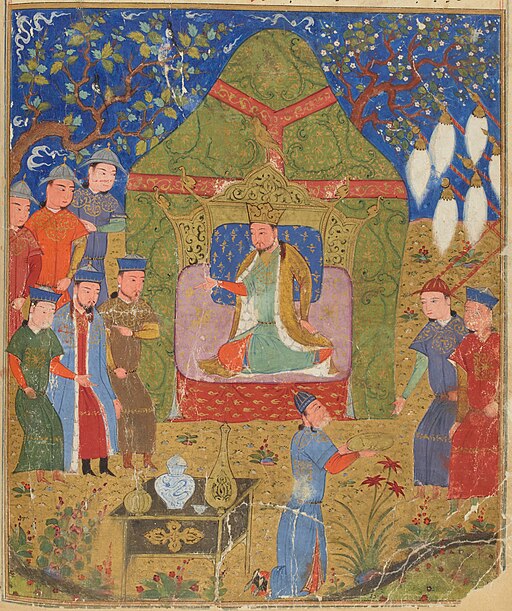 Temüjin being proclaimed as Genghis Khan in 1206, as illustrated in a 15th-century Jami' al-tawarikh manuscript.
Sayf al-Vâhidî. Hérât. Afghanistan, Public domain, via Wikimedia Commons
The Kalmyks, the only indigenous Mongolic and Buddhist people in Europe, trace their origins to the Oirat (or Oyirad) Mongols of western Mongolia and Dzungaria. While the Kalmyks are not direct patrilineal descendants of Genghis Khan (Chinggis Khan, 1162-1227) himself, their history intersects with his legacy through conquest, alliance, resistance, and shared Mongol heritage. The Oirats, ancestors of the Kalmyks, were distinct from the core "Nirun" Mongols (the Borjigin clan and allies) who formed Genghis Khan's original ulus in 1206.
The earliest documented interaction appears in the *Secret History of the Mongols* (13th century), which mentions the Oirats during Genghis Khan's rise. In one episode, Oirat chief Qutuqa Beki attempted to use a "yada" (thunder stone) to summon a storm against Genghis Khan's forces, but the wind reversed and harmed his own side. The Oirats initially resisted but were defeated and submitted. In 1207, Genghis Khan's eldest son Jochi led a campaign to subdue the northern "forest peoples" (Hoi-yin Irgen) - semi-nomadic tribes living in the taiga regions around Lake Baikal, the upper Yenisei, Angara, and Irtysh rivers (modern southern Siberia, Tuva, Buryatia, and northwestern Mongolia). These included the Oirats, Buriyat, Yenisei Kyrgyz, and others such as Ursut, Qabqanas, Tubas (Tuvans), and various smaller groups.
The campaign under Jochi was remarkably peaceful compared to many Mongol conquests. The Oirat leader Qutuqa Beki submitted early and voluntarily, guiding Jochi's forces to other tribes and facilitating their surrender without major bloodshed. In recognition of this swift loyalty, Genghis Khan arranged strategic marriage alliances to bind the Oirats closely to his family: his daughter Checheyigen (Čečeyigen) married an Oirat prince (Inalchi or Törölchi, son of Qutuqa Beki), and Jochi's daughter Qoluiqan married another Oirat leader (Törölchi or his brother). These quda (in-law) ties were a classic Mongol diplomatic tool to secure lasting alliances, integrate subordinates, and prevent future rebellions.
Following the successful submission, Genghis Khan formally placed the newly subjugated forest peoples - including the Oirats and their allies - under Jochi's authority. This meant Jochi received direct overlordship over these tribes as part of his personal domain (ulus or appanage). He gained administrative control, the right to collect tribute (such as furs, grain, falcons, horses, and gold from mines), access to their military manpower (tribal levies for future campaigns), and oversight of regional trade routes. Genghis Khan praised Jochi in the *Secret History* for his achievement: "You, eldest of my sons... you have been lucky. Without wounding or causing suffering to man or gelding in the lands where you went, you came back having subjugated the fortunate People of the Forest." This assignment expanded Jochi's western territories along the Irtysh River and laid the foundation for what became the Ulus of Jochi (later evolving into the Golden Horde after Jochi's death in 1225/1227), encompassing much of western Siberia, Kazakhstan, the Volga region, and beyond.
Despite this integration, the Oirats retained a separate identity as "western Mongols" or "forest peoples," distinct from the steppe-dwelling Eastern Mongols (Khalkha, Chahar, etc.) who claimed exclusive patrilineal descent from Genghis Khan via the Borjigin line. After Genghis Khan's death and the empire's fragmentation, the Oirats formed the Dörben Oirat confederation (Four Oirats: Khoshut, Torghut, Dörbet, Choros/Zunghar) and often positioned themselves as rivals to the Eastern Mongols, who monopolized the "Mongol" name and khan title as heirs to Genghis Khan.
A key link comes through Genghis Khan's younger brother, Qasar (Khasar or Habutu Hasar). Historical traditions and genealogies hold that the Khoshut tribe (one of the Four Oirats) was commanded by or descended from Qasar's line. This connection allowed some Oirat/Kalmyk groups, particularly Khoshut nobles in the Kalmyk Khanate (17th-18th centuries), to claim kinship with the imperial Borjigin family. Genetic studies support this: Y-chromosome analysis of Kalmyk Khoshut descendants shows haplogroup C3c1b-F6379 (a subclade of C2), prevalent among Oirats/Kalmyks (over 50% in samples) and linked to Qasar's patriline rather than Genghis Khan's direct Star Cluster (C2*-Star Cluster, found in only ~1.6% of Oirats). This suggests the Khoshut rulers' claimed descent from Qasar holds genetic plausibility, tying part of Kalmyk nobility to Genghis Khan's immediate family through his brother.
Overall, the connection is indirect and complex: early conquest and marriage alliances integrated Oirats into the Mongol Empire; later rivalry saw the Oirats challenge Eastern Mongol dominance; and specific clans (like Khoshut) preserved ties to Genghis Khan's siblings. The Kalmyks, migrating westward in the 17th century to form their Volga Khanate, carried this layered heritage - Mongol-speaking, Buddhist, nomadic - far from the steppe heartland, yet never claiming direct Borjigin descent like Eastern Mongols. Instead, they embodied a "western Mongol" alternative, resilient against assimilation while honoring shared steppe traditions rooted in the era of Genghis Khan.
- [1] Oirats - Wikipedia
- [2] Jochi - Wikipedia
- [3] Secret History of the Mongols - Wikipedia
- [4] Mongol campaigns in Siberia - Wikipedia
- [5] Y-chromosomal analysis of clan structure of Kalmyks - PMC
Posted on March 11, 2026 at 04:59 PM by Kalmyks.com
Type: Notable Kalmyks
Geshe Ngawang Wangyal (1901–1983): Kalmyk Buddhist Scholar and Lama and Key Figure in the Dalai Lama's 1959 Escape
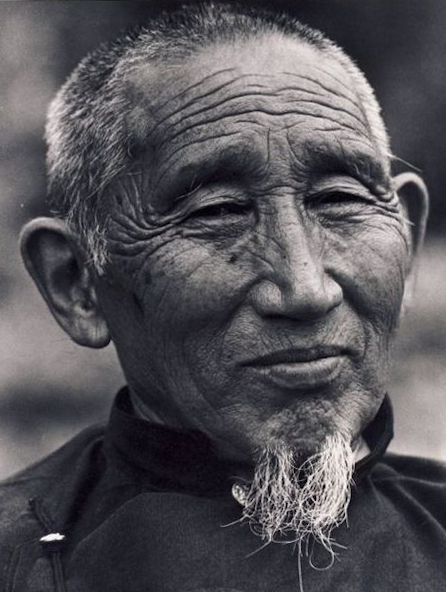
Geshe Ngawang Wangyal (1901-1983), a groundbreaking Kalmyk-Mongolian Buddhist scholar and monk, holds a unique place in the history of Tibetan Buddhism in the West. Born in the Astrakhan Governorate of Russia (now part of Kalmykia), he received his early monastic education in Kalmyk khuruls before traveling to Tibet in 1922, where he studied at Drepung Gomang Monastery and earned his geshe lharampa degree - the highest academic honor in Gelug Tibetan Buddhism. After earning his degree and fleeing Soviet persecution in Kalmykia, he arrived in the United States in February 1955 as part of a group of Kalmyk refugees resettled in Freewood Acres (now part of Howell Township), New Jersey. The Kalmyk community had already established their first temple, Rashi Gempil-Ling ("Sanctuary for the Increase of Auspiciousness and Virtue"), the first Kalmyk and Tibetan Buddhist temple in the Western Hemisphere.
Upon arrival, Geshe Wangyal sought to affiliate with the local Kalmyk Buddhist sangha and primarily associated with Rashi Gempil-Ling, where he contributed as a spiritual leader and teacher in the early years. As the highest-qualified scholar (with training in Kalmykia and Tibet), he supported rituals, teachings, and the preservation of Gelugpa traditions among the resettled Kalmyks.
Recognizing the need to transmit authentic Tibetan Buddhist teachings more broadly - especially to Western students interested in scholarly study and practice - Geshe Wangyal founded an independent center in 1958: the Lamaist Buddhist Monastery of America (LBMA), initially in Freewood Acres. This became the first dedicated Tibetan Buddhist dharma center in the West focused on rigorous academic and meditative training. In the late 1960s, he relocated it to Washington, New Jersey, renaming it Labsum Shedrub Ling (Tibetan Buddhist Learning Center), where it continues today. He trained pioneering American scholars like Robert Thurman and Jeffrey Hopkins, hosted His Holiness the 14th Dalai Lama during his landmark 1979 U.S. visit (which Geshe Wangyal helped facilitate), and advanced the intellectual credibility of Tibetan Buddhism in academia and beyond.
Shortly after his arrival in the U.S., around 1956-1957, Geshe Wangyal was recruited by the Central Intelligence Agency (CIA) with the assistance of Thubten Jigme Norbu (Takster Rinpoche, 1922-2008), the eldest brother of His Holiness the 14th Dalai Lama. Norbu, who had emigrated to the U.S. under CIA sponsorship in October 1957, had known Geshe Wangyal from their earlier time in Lhasa. As the only qualified Tibetan scholar in the U.S. at the time, Geshe Wangyal was an ideal candidate for the agency's needs amid the escalating Cold War and Chinese occupation of Tibet. His recruitment was part of the CIA's covert Tibet program, code-named ST Circus (also referred to as the Tibet Task Force), aimed at supporting Tibetan resistance against communist expansion.
Geshe Wangyal's primary contribution to the CIA was developing a specialized Tibetan telecode - a dictionary and encoding system that adapted the Tibetan script for secure Morse code transmission over radio. This innovative tool enabled reliable, encrypted communications between CIA-trained Tibetan guerrillas (including radio operators parachuted into Tibet) and their U.S. handlers. The telecode was crucial for coordinating operations, transmitting intelligence, and maintaining contact with resistance networks in remote Tibetan regions.
This system played a direct and pivotal role in the Dalai Lama's dramatic escape from Tibet in March 1959. Amid rising tensions in Lhasa following the Tibetan uprising on March 10, the 14th Dalai Lama fled his summer palace (Norbulingka) disguised as a soldier, accompanied by a small entourage. CIA-trained Tibetan radio operators joined the escape party and used Geshe Wangyal's telecode to send Morse code messages detailing the group's progress, coordinates, and status. In a suburban house outside Washington, D.C., Geshe Wangyal himself worked alongside CIA officer John Greaney, monitoring the wireless receiver and translating incoming Morse code transmissions from Tibetan into English using the special dictionary he had created. This allowed the CIA - and indirectly U.S. policymakers - to track the escape almost in real time, long before the world press knew of the Dalai Lama's fate. The guerrillas also employed the telecode to request political asylum from Indian Prime Minister Jawaharlal Nehru on behalf of the Dalai Lama, his cabinet, and family, facilitating their safe crossing into India on March 31, 1959. Without this secure communication capability, the escape might have faced greater risks from pursuing Chinese forces.
Geshe Wangyal continued his CIA contract work through 1960, after which he stepped away as the Tibet program evolved (it continued until the early 1970s under shifting U.S.-China relations). His involvement remained classified for decades, separate from his public spiritual activities.
Geshe Wangyal trained a remarkable group of Western students who became foundational figures in the academic and cultural transmission of Tibetan Buddhism in America. Among his most famous students were:
- Robert A. F. Thurman, Professor Emeritus of Indo-Tibetan Buddhist Studies at Columbia University, president and co-founder of Tibet House US, and author of numerous books on Tibetan Buddhism. Thurman was one of Geshe Wangyal's earliest resident students in the early 1960s, became the first American ordained as a Tibetan Buddhist monk (in 1964 by the Dalai Lama, whom Geshe Wangyal introduced him to), and later earned his PhD in Buddhist Studies. He credits Geshe Wangyal as his first guru and a life-saving influence.
- Jeffrey Hopkins, Professor Emeritus at the University of Virginia and a prolific translator of Tibetan Buddhist texts. Hopkins studied intensively under Geshe Wangyal starting in the early 1960s, contributing to the center's development while learning Tibetan and Buddhist philosophy. He went on to establish pioneering programs in Tibetan studies and served as the Dalai Lama's chief English translator for many years.
- Joshua and Diana Cutler, long-time directors of the Tibetan Buddhist Learning Center (Labsum Shedrub Ling), who began studying with Geshe Wangyal in the early 1970s. They oversaw major translation projects, including Tsongkhapa's Great Treatise on the Stages of the Path to Enlightenment.
- Other notable students included scholar and translator Alexander Berzin (founder of Study Buddhism), Anne C. Klein (Professor at Rice University and co-founder of Dawn Mountain Center), composer Philip Glass, painter Ted Seth Jacobs, and scholars like Leonard Zwilling, Michael J. Sweet, and Daniel P. Brown.
These students, often in exchange for teaching English to Tibetan monks sponsored by Geshe Wangyal, formed the first generation of Western Tibetan Buddhist scholars and practitioners. Geshe Wangyal's emphasis on rigorous textual study, language proficiency, and philosophical foundations helped establish Tibetan Buddhist studies as a serious academic field in the U.S., making him widely regarded as the "grandfather" of the discipline.
For the Kalmyk community, Geshe Wangyal represents resilience: bridging refugee hardships, Cold War geopolitics, and the global spread of the Dharma. His legacy endures through Labsum Shedrub Ling, which carries forward his vision of study and practice, while Rashi Gempil-Ling remains active in Howell, NJ, preserving Kalmyk traditions.
- [1] Ngawang Wangyal - Wikipedia
- [2] Geshe Ngawang Wangyal and Tibetan Buddhism in America - Tricycle
- [3] Geshe Ngawang Wangyal: America's First Pioneering Buddhist Lama - Tsem Rinpoche
- [4] History - Labsum Shedrub Ling
- [5] Rashi Gempil-Ling Buddhist Temple - Official Site
Posted on February 26, 2026 at 07:13 PM by Kalmyks.com
Type: Article
Tsagaan Sar 2026 (year 2153) - Year of the Fire Horse
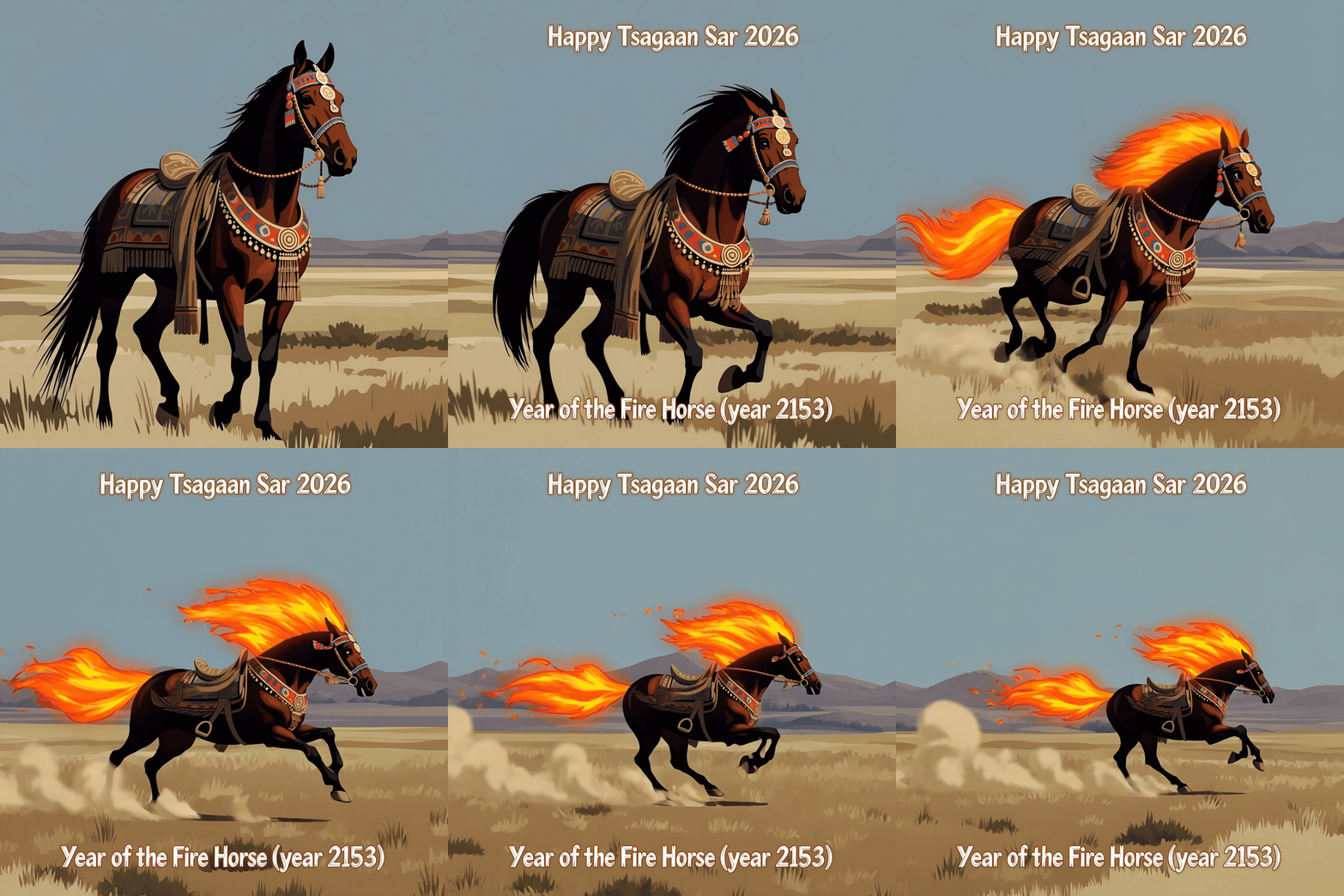
The White Month Festival in Kalmykia and the Mongolian World
Tsagaan Sar (Цаһан Сар / White Month) is the most important traditional holiday of the Kalmyk, Mongolian, Buryat, Tuvan and other Mongolic peoples. It is the celebration of the Mongolian lunisolar New Year, the arrival of spring, the awakening of nature after a long winter, purification, renewal and the beginning of a new life cycle.
In 2026 Tsagaan Sar begins on February 18 and is celebrated for several days (February 18–20). In the Republic of Kalmykia it has been declared an official non-working public holiday. For many Kalmyk families and communities in Russia, the United States and the diaspora this year carries special meaning because it is the Year of the Fire Horse (also called the Red Horse or Male Fire Horse).
According to the 60-year cycle of the lunisolar calendar (which combines 12 animals and 5 elements), 2026 is the year of the Horse combined with the Fire element. This combination occurs only once every 60 years and is considered very powerful and dynamic. In the traditional Kalmyk and Mongolian reckoning, this marks the year 2153 in their historical calendar cycle.
The 2153 refers to the year count in the Tibetan-Mongolian (or Kalmyk) era, which is based on a 60-year cycle (known as a "jar" or "rabjung" in Tibetan tradition) that began in 1027 CE with the year of the Fire Hare (Red Rabbit). This system counts years sequentially from that starting point, so 2026 CE corresponds to 2153 in this reckoning (calculated roughly as Gregorian year minus 1026, adjusted for the cycle start). It is a traditional way to denote the year in Buddhist and nomadic contexts among Mongolic peoples, distinct from the Gregorian calendar used globally today. Some traditions may reference slightly different starting points or variants (like Tibetan cycles at 2153, 1772, or others), but for Kalmyks and many Mongols, 2153 aligns with the Fire Horse year in 2026.
The Horse in Mongolian and Buddhist symbolism stands for:
- speed • freedom • energy • vitality
- nobility • perseverance • travel and movement
- in Buddhist context - the vehicle that carries the practitioner swiftly along the path of Dharma
The Fire element adds very strong yang qualities:
- passion • transformation • illumination • purification
- intensity • rapid change • burning away of the old
- strong creative and destructive potential at the same time
Together Fire Horse is considered one of the most energetic and fast-moving signs of the entire 60-year cycle. Many people describe it as "double fire" energy — movement + heat. It is a year of:
- bold decisions and quick actions
- big changes and unexpected turns
- high potential for personal growth and new beginnings
- at the same time — possible restlessness, impulsiveness and the need for careful channeling of energy
In Tibetan and Mongolian Buddhist tradition the Fire Horse year is often seen as especially favorable for spiritual practice, pilgrimages, rituals and energetic Dharma work — provided the practitioner can direct this powerful wind-horse (lung-ta) energy in a wholesome direction.
Traditional Tsagaan Sar customs in Kalmykia largely follow the common Mongolic pattern with some unique regional touches:
- Deep house cleaning and purification before the holiday (saying goodbye to the old year's negativities)
- Preparation of huge amounts of white food — the symbol of the holiday (milk products of all kinds: cheese, cottage cheese, butter, cream, milk tea, as well as buuz / poses, khorkhog in some families, sweets)
- Wearing the best traditional clothes (especially beautiful deel / terlig for women)
- The ritual of zolgokh — respectful greeting of elders with the younger placing arms under the elder's elbows and receiving blessings
- Exchanging gifts, white hadag scarves, sweets and best wishes
- Many families visit khurul (temple), attend special prayers and make offerings
- Feasting, singing traditional songs, playing games and spending time with extended family
A key spiritual element in Kalmykia is the temple services at local khuruls, including the central Golden Abode of Buddha Shakyamuni in Elista. Special rituals often begin on the eve of Tsagaan Sar (February 17, known as Bituun or the closing day of the old year). In many khuruls, monks hold an extended or vigil-like service that continues through the night, lasting until sunrise on February 18. This all-night practice helps purify negativities, accumulate merit, and welcome the new year with prayers, chanting, offerings to deities like Okon Tengri (the Kalmyk patroness), and rituals aligned with the lunar transition. For the public, participation is usually split to accommodate families: attendees may join in the evening, leave at night for rest at home, and return early (often around 6 a.m.) to greet the first sunrise of the new year with collective prayers and blessings. These sunrise moments are especially auspicious, symbolizing renewal and good fortune for the year ahead.
Because of its very powerful and fast energy, many lamas and elders advise people in the Year of the Fire Horse to keep mindfulness, avoid unnecessary conflicts, direct their energy constructively and especially cultivate compassion and patience.
For the Kalmyk people — both in the republic and in the worldwide diaspora — Tsagaan Sar 2026 (year 2153) is welcomed with special joy as the Fire Horse gallops in, carrying the promise of renewal, movement and bright new beginnings.
Happy Tsagaan Sar 2026! 🔥🐎
- [1] Tsagaan Sar - Wikipedia
- [2] Kalmyks.com - Tsagan Sar 2026 announcements
- [3] Tsagaan Sar 2026 | Blue Silk Travel
- [4] Kalmykia Marks the Sacred White Month with Buddhist Rituals - Buddhistdoor Global
Posted on February 16, 2026 at 02:17 PM by Kalmyks.com
Type: Article
Kalmykia Declares Tsagan Sar a Public Holiday for 2026
The national Kalmyk Buddhist New Year holiday Tsagan Sar, which falls on 18 February 2026 according to the lunar calendar, has been officially designated a non-working public holiday in the Republic of Kalmykia.
The decision, confirmed by decree of the Head of the Republic, gives residents an extra day off to observe traditional rituals, family gatherings and Buddhist ceremonies.
Posted on February 09, 2026 at 06:28 AM by Kalmyks.com
We welcome your feedback and suggestions. Please feel free to reach out to us with your ideas or if you would like to get involved. You can contact us at admin@kalmyks.com.