For the Kalmyk community worldwide, preserving our language, songs, epics, and traditions is a matter of cultural survival. One remarkable resource that has helped keep Kalmyk folk music alive - especially among the American diaspora - is the **Kalmyk Music Collection** curated by American folk musician Gordon Bok. Available online at https://gordonbok.com/kalmyk-music, this open-access archive offers a treasure trove of recordings, a songbook, and historical context that honors the resilience of Kalmyk immigrants who brought their heritage to the United States in the 1950s.
Gordon Bok, a renowned folk singer, songwriter, and maritime music specialist from Maine, first encountered Kalmyk music in the 1960s while working winters in Philadelphia. There, he befriended Kalmyk immigrants, sang with them, joined their small orchestra for dance events, and received personal recordings of songs and tunes. Over decades, Bok preserved these materials: amateur tapes from the 1960s-1970s, cleaned versions in 2003 by the Maine Folklife Center, and additional recordings he made into the 2000s during visits to the Philadelphia/New Jersey area. In 2011, he received a Lifetime Achievement Award at the New Jersey Folk Festival for his dedication to collecting and safeguarding Kalmyk folk music.
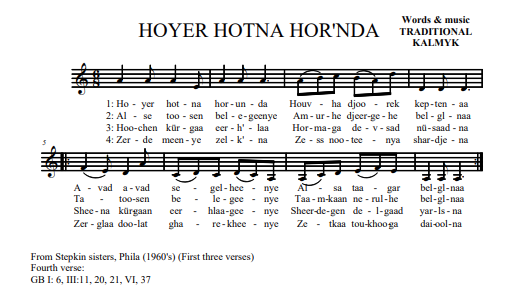
The heart of the collection consists of twelve compact discs (with track lists available on the site) containing music and spoken words from Kalmyk immigrants in New Jersey and Philadelphia. These include amateur home recordings, some featuring long songs in Derbet dialect, dance tunes, and newer songs popular among Bok's generation of friends. The archive also houses a downloadable PDF songbook, "Kalmyk Music: A Songbook," with phonetic transcriptions, simple melodic sketches (not full notations), and example audio tracks. Bok emphasizes that the sketches are guides only: "The tunes are not written down as they were sung. They are a melodic sketch and you must go to the originals in the collection to sing them as they were really sung."
The site includes Virginia Houpt's 1983 essay "Kalmyk Music: The Celebration of an Immigrant Culture," which explores how Kalmyk songs reflect centuries of migration and adaptation. Houpt writes: "One must respect the Kalmyks, for their culture is their home." Bok echoes this sentiment: "For 400 years, without a homeland, Kalmyks have kept their language, legends, epic songs and religion alive: that’s an amazing achievement. This is great, powerful music, unique in the world." He stresses the music's wandering nature - influenced by Russia, Mongolia, and other lands - and encourages freedom in performance: "There is NO right or wrong way to do this music. The only way you can hurt it is not to sing it."
Key contributors highlighted include Nadja Stepkin Budschalow (who kept many songs alive and taught them), Gawril and Allison Budschalow, Alex and Sara Goripow, Lidia and Gerel Buruschkin, Ginger Hildebrand, and others from the Philadelphia/New Jersey Kalmyk community. The recordings capture both traditional long songs and everyday tunes, preserving dialects and styles that might otherwise fade.
All files - audio tracks, CD creation notes (from 2002), track lists, Houpt's essay, and the songbook - are freely downloadable for listening, sharing, and personal use. Bok invites Kalmyks and others to contribute more recordings, translations, or context via email (music.timberhead@gmail.com) or phone (+1(207) 236-2707). Copies of the collection are held in the U.S. Library of Congress and the Austrian Academy of Sciences' Department of Vanishing Languages and Cultural Heritage, ensuring long-term preservation.
For Kalmyks in the diaspora - whether in New Jersey, Russia, or beyond - this collection is a living bridge to our ancestors' voices. It reminds us of the power of music to endure exile and inspire renewal. Visit https://gordonbok.com/kalmyk-music to explore, download, and perhaps add your own family's songs to this ongoing effort. As Gordon Bok says, the music lives when it is sung.