.png)
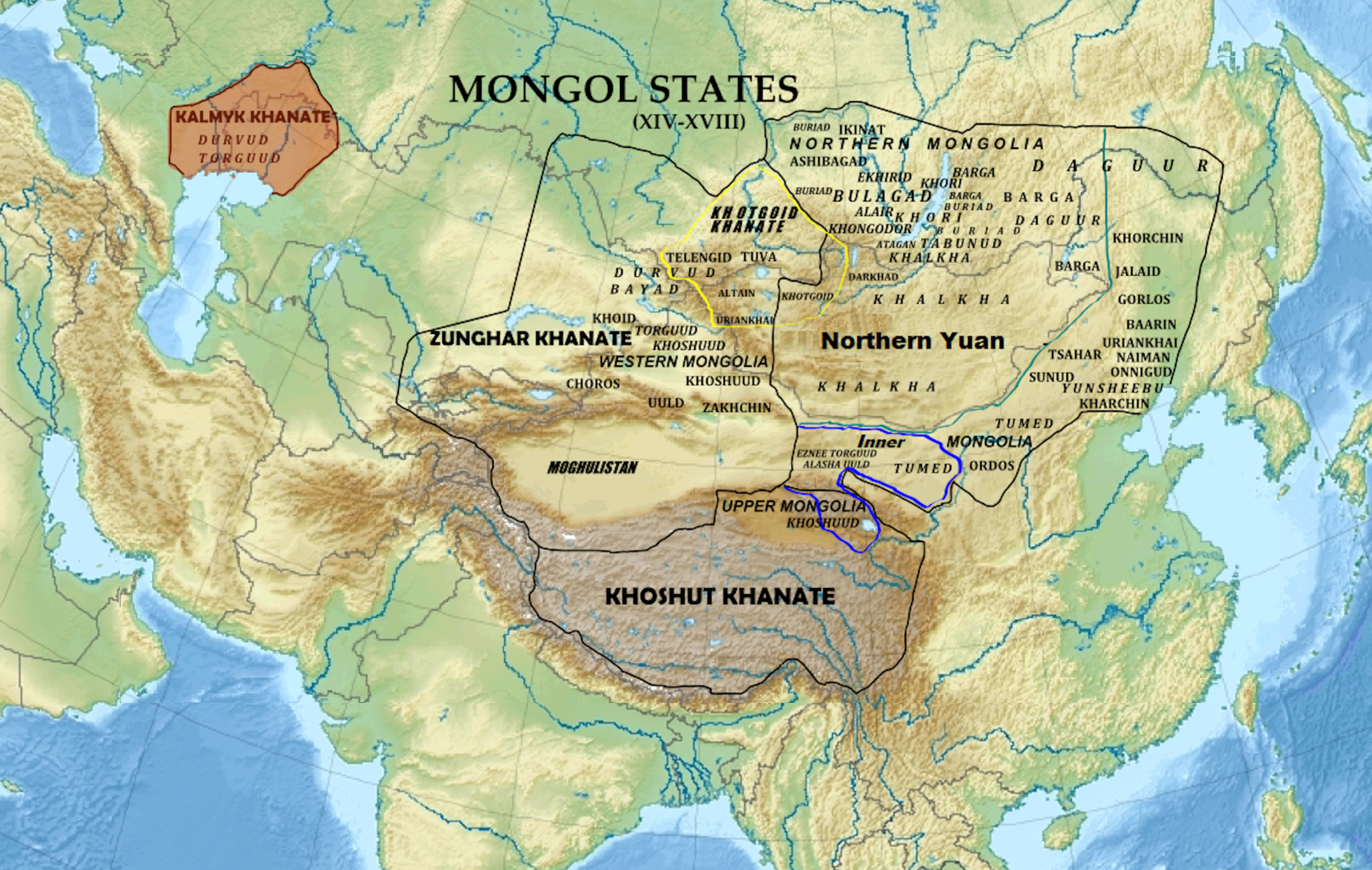
The Kalmyk Khanate was a nomadic state established in the 17th century by Oirat-speaking Mongols in the lower Volga region of what is now Russia. It represented the westernmost extension of Mongolian peoples and the only Buddhist-majority polity in Europe. Formed around 1630 by migrating Torghut, Dörbet, Khoshut, and other Oirat tribes, the Khanate served as a buffer for the Tsardom of Russia against southern Muslim powers while maintaining significant autonomy until its abolition in 1771. The Kalmyks, as they came to be known (from a Turkic term meaning "remnant"), preserved a rich nomadic heritage blending Mongol traditions, Tibetan Buddhism, and interactions with neighboring cultures.[1][2]
The origins trace to the early 17th century, when Oirat tribes faced overcrowding, internal conflicts over Dzungar centralization, and territorial pressures from Russians, Kazakhs, and Dzungars in their homeland near the upper Irtysh River in Dzungaria (modern western Mongolia, northern Xinjiang, and eastern Kazakhstan). In 1618-1630, led by Kho Orluk of the Torghuts and Dalai Batur of the Dörbets, an estimated 200,000-250,000 people migrated westward through southern Siberia and the Ural Mountains. They raided Russian settlements, Kazakh encampments, and Bashkir territories en route to avoid direct confrontations. Upon reaching the Volga steppes - formerly part of the Astrakhan Khanate but claimed by Russia - they encamped on lightly populated lands south of Saratov to Astrakhan, on both banks of the Volga. The migrants expelled most of the Nogai Horde, forcing many to flee to the North Caucasus, Black Sea steppe under the Crimean Khanate, or seek Russian protection. By 1639, they overtook the Mangyshlak Peninsula after battling Karakalpak tribes. The Khanate was formally recognized when Elizabeth of Russia granted a banner to Donduk Dashi as Khan in the mid-18th century.[1][2]
The Khanate was a hereditary monarchy ruled by Khans from the Torghut tribe, with a list of rulers including: Kho Orluk (1633-1644), Shukhur Daichin (1644-1661), Puntsug (Monchak) (1661-1672), Ayuka Khan (1672-1724), Tseren Donduk Khan (1724-1735), Donduk Ombo Khan (1735-1741), Donduk Dashi Khan (1741-1761), and Ubashi Khan (1761-1771). Governance followed the Great Code of the Nomads (Iki Tsaadzhin Bichig), a 1640 legal framework ratified at a congress near the Tarbagatai Mountains. This code, blending Oirat customs, Mongol traditions, and Buddhist ethics, regulated social relations, criminal punishments (often fines in livestock), military duties, property, and religious practices. It emphasized humane treatment and communal harmony, serving as the basis for self-rule despite nominal oaths of allegiance to Russia.[1][2]
During the period of self-rule (1630-1724), the Khanate enjoyed considerable independence. Relations with Russia were uneasy, marked by mutual raids - Kalmyks on Russian settlements, Cossacks and Bashkirs on Kalmyk encampments - but stabilized through treaties exchanging military aid for subsidies, weapons, and trade privileges. Under Ayuka Khan, the Khanate peaked, subjugating Mangyshlak Turkmens, allying with Russia against Muslim foes, and conducting expeditions against North Caucasian highlanders. Prosperity came from tariff-free trade at Russian border towns like Astrakhan, Tsaritsyn, and Saratov, bartering livestock and Asian/Muslim goods for Russian textiles, metals, grain, and brick tea. Intermarriage with Tatars and Bashkirs was common, fostering cultural exchanges.[1][2]
The Kalmyk Khanate was involved in numerous invasions, wars, and raids, often as Russian allies against southern threats but also in independent campaigns. A comprehensive list from historical records includes:
- 1603: Attacked the Khanate of Khiva, devastating parts of the Bukhara Khanate.[1]
- 1607: Major clash with the Kazakh Khanate; repelled by Esim Sultan, leading to loss of West Kazakhstan territory.[1]
- 1619: Moved south to Derbend, capturing Nogais after the 1607 defeat.[1]
- 1620: Attacked Bashkirs.[1]
- 1635: Winter war against Astrakhan Tatars.[1]
- 1644: Major invasion of Kabardia in the North Caucasus, targeting Kabardians and other peoples.[1][3]
- 1650: Raided the Astarabad region in northeastern Iran; sent messengers to the Persian Shah.[1]
- 1658: Successful campaign against Crimean Tatars and Nogais.[1]
- 1660: In Tomsk, killed many men and captured over 700 women and children.[1]
- 1661 (June 11): War with the Crimean Khan.[1]
- 1666: At Russian request, fought in Ukraine against Tatars, Turks, and Poles.[1]
- 1668: Allied with Cossacks in a campaign against Crimea.[1]
- 1676: Led by Mazan Batyr, participated in the Russo-Turkish War; allied with Kabardians against Turkish-Crimean forces up to Kiev and Chuguev.[1]
- 1678: Repulsed by combined forces; defeated Crimean Khan Murad Giray.[1]
- 1680: Raided Penza.[1]
- 1684: Captured Sairam; Ayuka Khan campaigned against Kazakhs, Turkmens, and Karakalpaks.[1]
- 1696: Participated in the capture of Azov.[1]
- 1698: Raided Crimean Tatars in southern Russia and Ukraine.[1]
- 1700: Involved in the Great Northern War, including the Battle of Poltava.[1]
- 1711: 20,474 Kalmyks and 4,100 Russians attacked Kuban; killed 11,460 Nogais, drowned 5,060, seized 2,000 camels, 39,200 horses, 190,000 cattle, 220,000 sheep, and 22,100 captives (700 adult males); defeated a returning Nogai party and freed 2,000 Russian captives.[1]
- 1735: Involved in the Russian-Turkish War; successful campaigns in Kuban and Crimea.[1]
- 1741: Detachments in the Russian-Swedish War.[1]
- 1756-1761: Participated in the Seven Years' War.[1]
- Post-1771: Remaining Kalmyks joined Pugachev's Rebellion (1773-1775), Russian Civil War (1917-1920, split between White and Red forces), and WWII (some collaborated with Germans, leading to 1943 deportations).[2]
Geographically, the Khanate spanned modern Kalmykia, Stavropol, Astrakhan, and parts of the North Caucasus, centered on the Eurasian steppe along the lower Volga. Its economy was pastoral nomadic, reliant on herding sheep, cattle, horses, goats, camels, and donkeys. Trade was vital, with free exchanges at Russian borders and with Qing China, Tibet, and Muslim neighbors. Society was tribal, organized into ulus (divisions) under noyons (princes) or taishi (chieftains), with subgroups like Torghuts (dominant), Dörbets, Khoshuts, Buzavas, Choros, Khoits, and Bayids. Intertribal rivalries existed, but the Code ensured order. Customs included seasonal migrations for grazing, living in portable yurts (ghers) - round, lattice-walled tents covered in felt with rafters and tension bands. Traditions emphasized kinship, patrilineal inheritance, and communal obligations. Diplomatic etiquette involved rituals for alliances and treaties. Oral traditions were rich, including heroic epics like the Jangar cycle, recited by jangarchi singers. Music, dances, and colorful clothing (e.g., deel robes) reflected vibrant culture. Some minorities practiced Islam (e.g., Tomuts from mixed marriages) or shamanism/Tengrism.[2][4][5]
Religion was predominantly Tibetan Buddhism (Vajrayana, Gelugpa sect), adopted in the early 17th century via Khoshut leaders like Baibagas Khan and Güshi Khan. The 1640 Code reinforced Gelugpa unity. Clergy trained locally or in Tibet, with mobile tent monasteries (khuruls) or fixed stone ones. Lamas offered spiritual, medical, and political guidance. Tsarist pressures for Orthodox conversion existed, but Buddhism endured. Soviet suppression (1920s-1940s) destroyed temples; revival post-1980s led to 21 khuruls by 1995, including Europe's largest, Burkhan Bakshin Altan Sume in Elista (2005).[2][6]
Autonomy eroded after 1724 due to Russian settlements on pastures, imposed councils diluting Khan power, and Orthodox proselytizing. By the mid-18th century, disillusionment peaked. In 1771, amid the Russo-Turkish War, Ubashi Khan led an exodus of 170,000-200,000 Kalmyks (33,000 households, mostly Torghuts) back to Dzungaria, seeking independence under Qing rule. Blessed by the Dalai Lama (who consulted astrology for the departure), the journey involved 6 million animals but suffered Kazakh raids, starvation, thirst, and cold, with only 66,000-70,000 survivors reaching Lake Balkhash. Catherine II abolished the Khanate in October 1771, executing nobles and placing remnants under Astrakhan governance. Remaining 100,000-150,000 (mostly Dörbets, Khoshuts, Buzavas) faced further hardships, including Pugachev's Rebellion, Civil War splits, and WWII deportations (1943-1957, with 97,000-98,000 deaths).[1][2]
The Khanate's legacy endures in Kalmykia's cultural revival, with preserved epics, Buddhism, and nomadic traditions. As Europe's sole indigenous Buddhist community, the Kalmyks symbolize resilience amid migrations, wars, and oppression.[2][7]