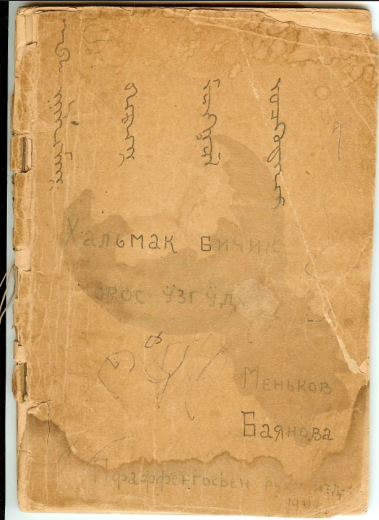
One of the most precious surviving artifacts of Kalmyk exile education has surfaced: a hand-duplicated children’s primer titled **Халъмак бичик** (Kalmyk Book) and **Брос узгул** (First Reader / Alphabet Learning). Produced in 1947 in a German Displaced Persons (DP) camp and based on a 1940 manuscript, this 27-page booklet was compiled by Menkov, Bayanova and others and marked "Als Manuskript vervielfältigt" (reproduced as manuscript). Priced at 5 RM, it was created specifically for Kalmyk children living in the uncertainty of post-World War II camps in Germany.
Download The 1947 Primer From Kalmyks.com
After the war, thousands of Kalmyks found themselves in DP camps across Germany. Many had fled Soviet repression or had been displaced during the conflict. In these camps they quickly organized schools, temples and cultural activities to keep their language and identity alive. This little primer is a direct product of that determination - a lovingly handmade textbook that taught reading, writing, arithmetic, calendar knowledge and Buddhist values using the traditional Clear Script (Todo Bichig), with Cyrillic and phonetic support for the new generation born in exile.
The book is richly illustrated with hand-drawn pictures on almost every page: apples, horses, cows, yurts, traditional clothing, musical instruments, beds, keys, bows, nests, clouds, and everyday objects. These drawings turn each lesson into a visual vocabulary builder. The style is warm and child-friendly, clearly made with love by people who knew their culture might not survive without such efforts.
Here are translations and summaries of some of the most meaningful pages:
Page 5 - Buddhist Refuge Prayer (one of the earliest Kalmyk children’s prayers preserved from the DP period)
The text is a beautiful Kalmyk adaptation of the Three Jewels refuge formula:
"Лоёр көлү нугудын дэл Бурхнд иткмү
Лама орчланг кигял,
Му заятын аюл эц,
Ёвякин Бакш болн сөрхүн.
Тачаңы эц хакцкын
Нугудын дэл Нопд иткмү
Лама орчланг кигял
Му заятын аюл эц,
Ёвякин бүдн болн сөрхтн.
Цулын нугудын дэл,
Хорвокт иткмү
Лама орчланг кигял,
Му заятын аюл эц,
Ёвякин хань нөкөл,
Болн сөрхтн."
Translation:
"I take refuge in the Buddha, the Teacher of the world,
who frees us from the dangers of bad rebirths,
the precious Guru and protector.
I take refuge in the Dharma, the precious Teaching,
who frees us from the dangers of bad rebirths,
the precious Sangha and protector.
I take refuge in the Sangha, the community of noble ones,
who frees us from the dangers of bad rebirths,
the precious friends and protectors."
This prayer taught even the youngest children the core of Gelug Buddhist faith while they were far from their homeland.
Pages 3-4, 6-7, 9, 12 - Alphabet and Vocabulary Lessons
Letters are introduced with charming drawings:
- "A a" - apple
- "M m" - horse ("Ma-ma Ma", "Am-am Au")
- "U u" - bucket, nest, bottle
- "K k" - traditional Kalmyk clothing and hats
Simple words and phrases accompany each picture so children could connect written Kalmyk with everyday life.
Pages 8, 10-11, 20-21 - Arithmetic
Basic addition and subtraction tables are presented clearly, with examples such as: 1-1=0, 2-1=1 … up to 10-1=9 and more complex sums. These were essential skills for children whose families were rebuilding their lives from nothing.
Page 10 - Calendar and Zodiac
A beautiful double-page spread lists the 12 months and the 12 animal signs in Kalmyk (Тула / Rabbit, Лу / Dragon, Мога / Snake, Мөрн / Horse, etc.) alongside the Gregorian calendar - helping children navigate both their traditional lunar calendar and the Western one they encountered in Europe.
Later pages - Short texts and cultural content
Simple sentences about yurts ("Хальмак герь айта" - The Kalmyk yurt is beautiful), family life, nature, and daily objects. One page even shows a traditional Kalmyk woman in national dress.
This modest 27-page booklet is far more than a schoolbook. It is living proof of Kalmyk resilience: in the ruins of post-war Europe, our grandparents and great-grandparents refused to let the language, script, faith and culture die. Every drawing, every prayer, every letter was an act of cultural survival.
Today, thanks to this surviving copy, we can see exactly how our people taught their children in the DP camps of 1947. It stands as a powerful reminder that no matter where Kalmyks have been scattered - Germany, America, Australia, or back in Kalmykia - the flame of our language and heritage has never been extinguished.
If you have family stories from the German DP camps or other early Kalmyk primers, please share them with us at Kalmyks.com. These fragile books are part of our living history.
Сар шүүдэр мөргөе!
Хальмак келн мандан үлзг!
The front cover credits the original 1940 primer to:
Меньков (Menkov)
Баянова (Bayanova)
Reproduced or printed this edition by Sandscha Zagadinow in 1947.
In the DP camps, someone had to organize the mimeographing or hand-duplication of books. Sandscha Zagadinow took on that role for this little primer - he is the producer/publisher of the 1947 camp edition.