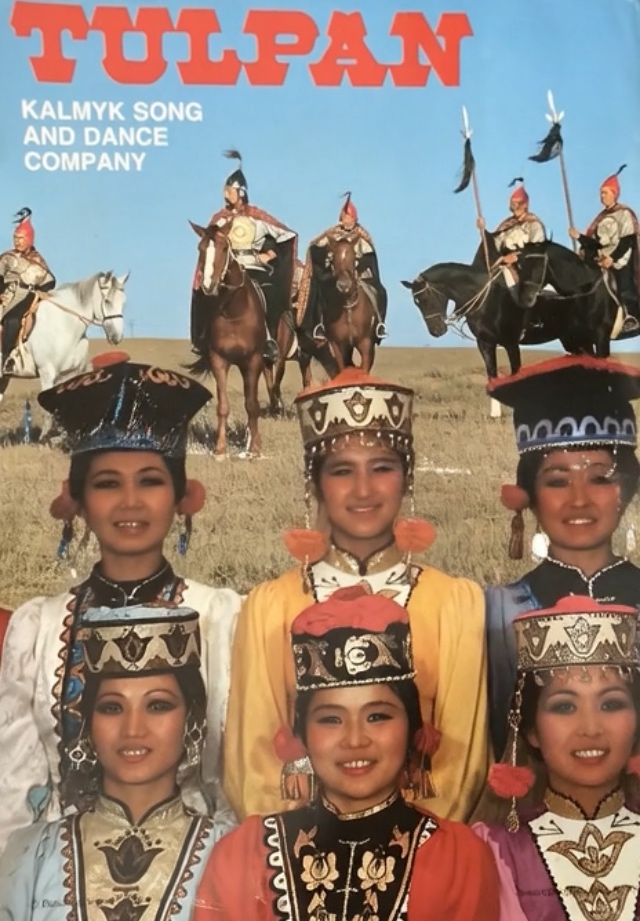
The State Dance Ensemble “Tulpan” (Kalmyk: Тюльпан, meaning “Tulip”) is the premier professional folk dance company of the Republic of Kalmykia, Russia, and one of the most recognized ambassadors of Kalmyk performing arts worldwide.[1] Founded in 1937 in Elista as the Song and Dance Ensemble of the Kalmyk ASSR, Tulpan has continuously preserved, developed, and popularized Kalmyk, Oirat-Mongolian, and broader Eurasian steppe dance traditions for over eight decades.
From its inception, Tulpan played a vital role in documenting and staging Kalmyk dances that had previously existed only in nomadic or ritual contexts. Dances such as the circular “Yor Yalyn Bääldl” (Dance of Good Wishes), the warrior-inspired “Chichirdyg,” the women’s graceful “Syalykin Bya,” and the energetic “Ishkimdik” were systematized and choreographed for the stage by early directors including Pyotr Chonkunov and Maria Mandzhieva.[2] These stylizations retained authentic footwork, arm gestures, and costume elements—embroidered terligs, silver jewelry, and tall headdresses—while adapting them for theatrical presentation.
The ensemble’s history mirrors the dramatic fate of the Kalmyk people. In 1943, when the entire Kalmyk nation was deported to Siberia, Tulpan was disbanded and many of its artists perished or were scattered. After rehabilitation in 1957, the company was re-established in Elista under the leadership of Pyotr Nadbitov and later the legendary choreographer Vasily Khakhuchev (People’s Artist of the RSFSR). The revival period (1958–1990) produced signature large-scale works such as “My Kalmykia,” “Steppe Legends,” and “The Epic of Jangar in Dance,” which fused traditional motifs with symphonic accompaniment and modern ballet technique.[3]
Since the 1990s, under artistic director Larisa Byurchieva and later Boris Mandzhiev, Tulpan has toured extensively across Russia, Europe, Asia, and the Americas, performing at venues including the Bolshoi Theatre, UNESCO headquarters in Paris, and the Kennedy Center in Washington, D.C.[4] The ensemble’s repertoire now exceeds 100 numbers and incorporates contemporary interpretations, such as the acclaimed “Prayer for Peace” and collaborations with throat-singing and morin khuur musicians from Mongolia and Inner Mongolia.
Beyond performance, Tulpan functions as a living archive and school. Its studio trains the next generation of dancers, many of whom go on to join the company or teach in Kalmykia’s children’s ensembles. In 2021 the ensemble celebrated its 85th anniversary with a gala concert attended by high-ranking Russian officials, underscoring its status as a national treasure.[5] Today, Tulpan remains the most visible and vibrant expression of Kalmyk identity on the global stage, transforming ancient steppe rhythms into a dynamic language that speaks simultaneously of heritage and renewal.