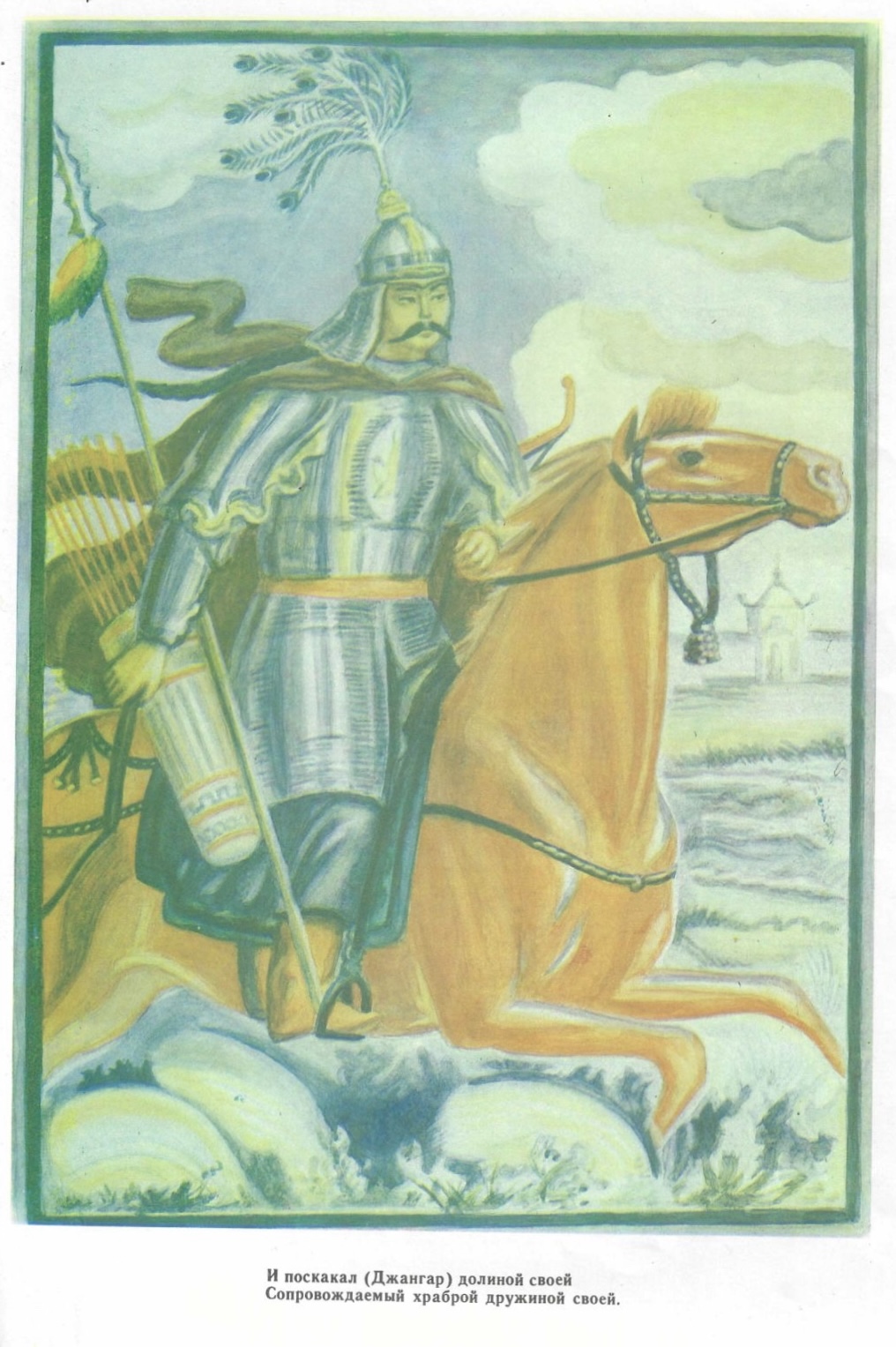
The Epic of Jangar, referred to in Mongolian as Jangar tuuli, constitutes a cornerstone of Kalmyk cultural heritage. This extensive oral epic poem centers on the heroic deeds of Jangar, a legendary warrior-king who establishes and safeguards a utopian realm known as Bumba. Long regarded as a distinctly Kalmyk tradition, it is now recognized as a broader Oirat-Mongol epic shared among communities in Russia, Mongolia, and China, transcending its initial classification as an exclusively Kalmyk tradition.[1]
Historical and Cultural Origins
The epic's roots extend to the medieval Mongol Empire, particularly the Oirat confederation active during the 13th century under Genghis Khan. The Kalmyks, as descendants of these Oirats, migrated westward in the 17th century to the Caspian steppes, forming Europe's sole indigenous Buddhist population. Scholars posit the epic's development between the 15th and 17th centuries, during which it functioned to preserve ethnic identity, moral principles, and cosmological views amid migration and external pressures.[2]
First transcribed in the 19th century by Russian ethnographers, Jangar remains vibrant through oral performance. Its narrative geography spans from the Indian Ocean to Mount Elbrus, designated as Mingi-Tau in Kalmyk tradition, reflecting the expansive nomadic worldview.[1]
Narrative Structure and Plot Summary
Jangar comprises a cyclical structure with approximately 25 to 26 core chapters, though variants may exceed 100, permitting significant improvisation. The storyline integrates historical resonances with mythic elements, potentially surpassing 100,000 lines in complete recitation.[3]
The epic begins with Jangar's ancestral lineage of benevolent khans who create Bumba as an idyllic haven after escaping tyranny. Catastrophes, including blizzards, famines, and invasions by demonic Manggus lords, decimate prior generations. Jangar emerges miraculously from a "red mass" under prophetic signs, nurtured by wild animals, and at age three defeats the antagonist Goljing to reclaim Bumba. Subsequent episodes involve conquests, retrieval of magical artifacts, and battles against figures such as Shar Durdeng and Altan Gheej, culminating in Bumba's eternal stabilization.[2]
Principal Characters and Archetypes
The epic features a diverse cast embodying nomadic ideals:
- Jangar: The protagonist, marked by divine birth omens, exemplifying martial prowess and ethical governance.
- Ujung Aldar and Urmaa: Jangar's parents, whose union symbolizes fertility and natural harmony.
- Aranjagaan: Jangar's mythical stallion, representing loyalty and endurance.
- Antagonists: Manggus demons and rival khans embodying chaos.
- Allies: Figures like Master Choirom and animal mentors providing guidance and strength.[3]
Themes and Symbolic Motifs
Jangar explores profound motifs resonant with nomadic existentialism:
- Heroism and Destiny: Jangar's precocious feats underscore predestined greatness, tempered by ethical leadership and mercy toward the vanquished.
- Nature and Cosmology: Animals as nurturers and omens reflect shamanistic animism; Bumba's creation evokes a lost Eden, threatened by environmental and human-induced cataclysms.
- Social Harmony: Advocacy for equality, aid to the vulnerable, and rejection of ethnic strife promote an ideal society, contrasting the epic's violent conquests.
- Love and Fertility: Romantic vignettes, such as Jangar's parents' courtship inspired by swans, intertwine eros with procreation rituals, celebrating life's cyclical renewal.
- Conflict with Chaos: Battles against Mangguses symbolize the eternal struggle between order (Bumba's prosperity) and disorder (invasion and decay).
Performance Tradition and Preservation
Performed by specialized singers known as jangarchi, the epic is recited unaccompanied during communal events, with improvisations enhancing fixed motifs. Notable performers include Eelian Ovla and contemporary artists such as Basang Gorzhaev.
Early recordings on wax cylinders and modern digital media ensure continuity, with performances documented in venues like Elista's festivals.[2]
Contemporary Significance and Adaptations
Jangar endures as a symbol of Kalmyk resilience against assimilation and language decline. The 2022 English translation by Saglar Bougdaeva presents 12 chapters to international readers. Adaptations encompass the 2016 Chinese animated film Hero Jianger, a 1990 Soviet commemorative stamp, and cultural centers in Xinjiang. Ongoing scholarship and digital dissemination engage new generations while affirming ethnic identity.[3]