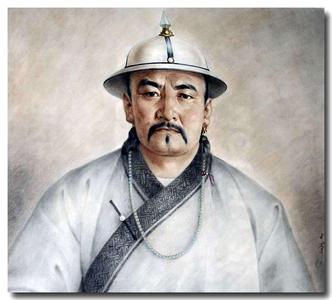
Galdan Boshugtu Khan (1644–1697), a prominent figure in Oirat Mongol history, ruled as khan of the Dzungar Khanate from 1671 until his death, emerging as a unifier of the Oirat tribes and a formidable challenger to the Qing Dynasty.[1] As a descendant of Esen Taishi of the Northern Yuan and fourth son of Erdeni Batur, founder of the Dzungar Khanate, Galdan embodied the martial and spiritual traditions of the Oirats, ancestors of the modern Kalmyks. His life and campaigns significantly influenced the broader Oirat-Kalmyk narrative, representing a period of expansion and resistance that echoed in Kalmyk oral traditions and historiography long after their migration to the Volga region.
Born in 1644, Galdan was sent to Tibet at age 13, where he studied for two decades under the 5th Dalai Lama and the 4th Panchen Lama, mastering Buddhist philosophy, astronomy, medicine, and other sciences.[2] This religious education shaped his worldview, earning him the title "Boshugtu Khan" (meaning "sacred" or "blessed") from the Dalai Lama in 1679. Upon the murder of his brother Sengge in 1671 by rival half-brothers, Galdan renounced his monastic vows, returned to Dzungaria, and avenged the death with support from Ochirtu Khan of the Khoshut. By 1678, he had consolidated power over the Oirats, marrying Sengge's widow, Queen Anu, and establishing a centralized rule that promoted Gelug Buddhism among the tribes.
Galdan's military achievements expanded Oirat influence across Central Asia. In 1677, at the Dalai Lama's behest, he conquered Altishahr (the Tarim Basin), overthrowing the Black Mountain Khoja and installing Afaq Khoja as a puppet ruler, securing control over Kashgar, Yarkant, Turfan, and Hami by 1682.[3] He subjugated the Kazakhs, defeating Tauke Khan and occupying territories up to Tashkent and the Syr Darya, while ravaging the Fergana Valley. These conquests marked the zenith of Dzungar power, fostering trade and cultural exchanges that enriched Oirat society.
However, Galdan's ambitions led to devastating conflicts. In 1688, he invaded Khalkha Mongol territories, allying briefly with Russia and forcing the Jebtsundamba Khutuktu to flee, but this provoked Qing intervention under Emperor Kangxi.[4] The ensuing Dzungar-Qing wars culminated in defeats, including the 1696 Battle of Zuunmod, where Queen Anu perished heroically. Betrayed by his nephew Tsewang Rabtan and reduced to a few followers, Galdan committed suicide by poison in the Altai Mountains near Khovd on April 4, 1697.
In Kalmyk history, Galdan represents the enduring spirit of Oirat unity and resistance against imperial forces, themes preserved in Kalmyk folklore and epics like the Jangar cycle.[5] While the Kalmyks had migrated westward to the Volga by the early 17th century, Galdan's era in the remaining Oirat heartlands reinforced their shared identity as descendants of Genghisid legacies. His promotion of Buddhism aligned with Kalmyk adoption of Gelug traditions, and his story is commemorated in Kalmyk literature, such as "The Story of the Oirat Galdan Boshoktu-Khan." Today, he symbolizes Oirat resilience amid historical dispersions, influencing cultural revivals in Kalmykia and beyond.