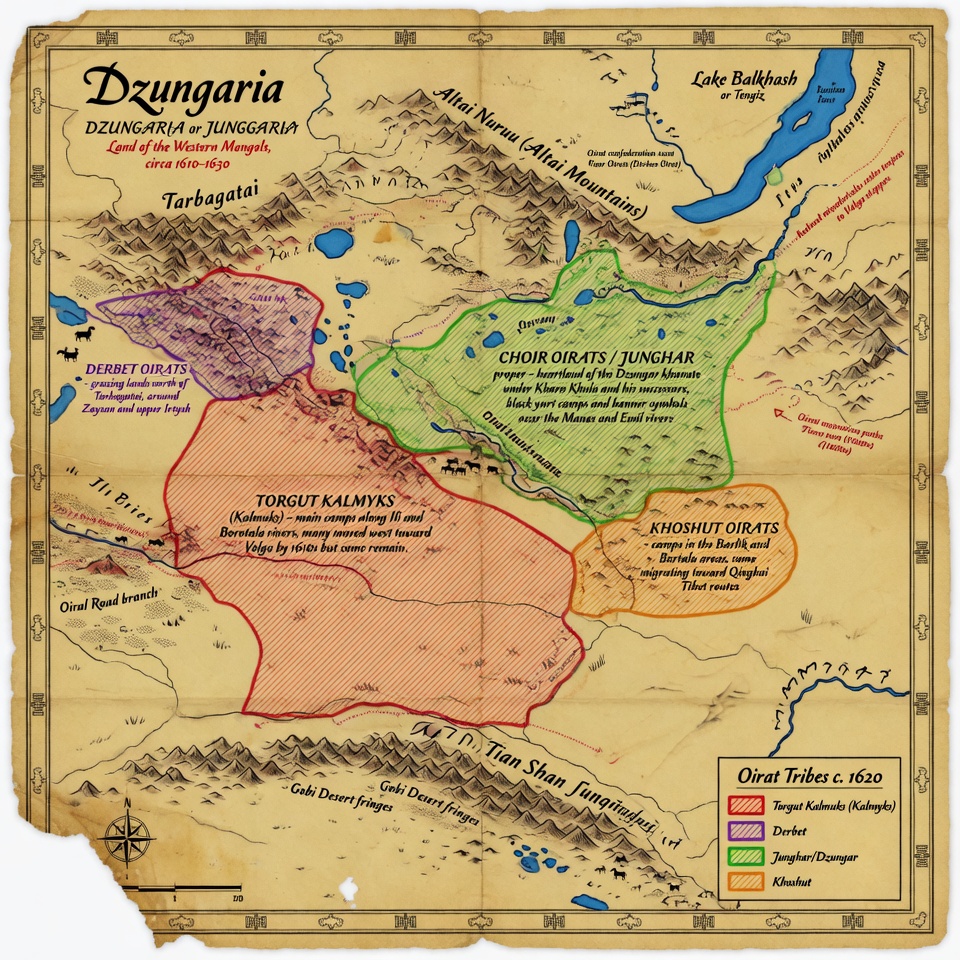
Dzungaria, also known as Zungharia or Junggar Basin, is a vast semi-arid region in northwestern Inner Asia, roughly corresponding to northern Xinjiang Uyghur Autonomous Region in China, parts of eastern Kazakhstan, and western Mongolia. Bounded by the Altai Mountains to the north, the Tian Shan to the south, and the Ili River valley, it features steppe grasslands, deserts, and oases ideal for nomadic pastoralism. Historically, it served as the heartland of the Oirat Mongols, western branches of the Mongolic peoples who practiced Tibetan Buddhism and maintained distinct confederations separate from eastern Mongols.
In the early 17th century, Dzungaria was the origin point for the Kalmyk migration. Facing internal rivalries, pasture shortages, and pressures from emerging Dzungar centralization under leaders like Erdeni Batur, large groups of Oirat tribes - primarily Torghuts under Kho Orluk, along with Dörbets, Khoshuts, and others - departed westward around 1618-1630. An estimated 200,000-250,000 people crossed southern Siberia, raiding Kazakh, Bashkir, and Nogai territories en route, before settling in the lower Volga steppes by the 1630s. This exodus created the Kalmyk Khanate, marking the Kalmyks as the westernmost Mongolic people and Europe's only indigenous Buddhist population.
Dzungaria remained the core of the Oirat confederation, evolving into the powerful Dzungar Khanate (c. 1634-1758) under Choros-led rulers like Galdan Boshugtu Khan and Tsewang Rabtan. The Dzungars expanded aggressively, clashing with Kazakhs, Qing China, and others, while maintaining cultural and religious ties with the distant Kalmyks. The 1640 Great Code of the Nomads (Iki Tsaadzhin Bichig), ratified near the Tarbagatai Mountains in Dzungaria, united Oirat tribes (including Kalmyk forebears) under Gelug Buddhism and common laws, symbolizing shared heritage despite geographic separation.
The region's significance deepened in 1771 during the Kalmyk exodus. Disillusioned by Russian encroachment on pastures, autonomy erosion, and Orthodox pressures, Ubashi Khan led 170,000-200,000 Kalmyks (mostly Torghuts) back to Dzungaria, seeking to restore independence under Qing rule. The Dalai Lama's astrological blessing underscored spiritual links to the ancestral land. The grueling journey across steppes claimed most lives due to Kazakh raids, starvation, and harsh weather, with only 66,000-70,000 survivors arriving. Catherine II abolished the Kalmyk Khanate, and remaining Kalmyks integrated further into Russia. Survivors in Dzungaria dispersed among Oirat remnants, some resettled by the Qing.
Today, Dzungaria holds profound symbolic importance for Kalmyks as their ancestral homeland and origin of their nomadic, Buddhist identity. It represents lost unity with other Oirats (now Torghuts in China/Mongolia), shared epics like Jangar, and resilience through migration. Modern Kalmyks view it as a cultural root, with historical memory preserved in folklore, scholarship, and ties to Mongolian Buddhist traditions amid ongoing revival in Kalmykia.