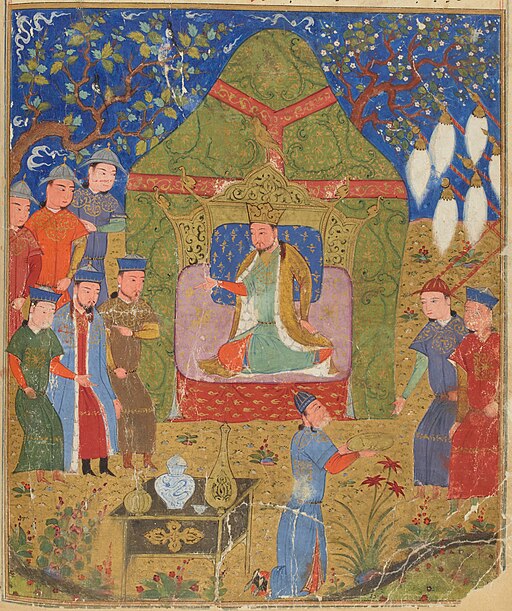
The Kalmyks are the only Mongolic people in Europe, and Kalmykia is Europe's only Buddhist-majority region. They trace their origins to the Oirat (or Oyirad) Mongols of western Mongolia and Dzungaria. While the Kalmyks are not direct patrilineal descendants of Genghis Khan (Chinggis Khan, 1162-1227) himself, their history intersects with his legacy through conquest, alliance, resistance, and shared Mongol heritage. The Oirats, ancestors of the Kalmyks, were distinct from the core "Nirun" Mongols (the Borjigin clan and allies) who formed Genghis Khan's original ulus in 1206.
The earliest documented interaction appears in the Secret History of the Mongols (13th century), which mentions the Oirats during Genghis Khan's rise. Around 1201-1202, at the Battle of Köyiten, Oirat chief Qutuqa Beki sided with Jamukha and Naiman Buyruq Khan and attempted to use a "yada" (thunder stone) to summon a storm against Genghis Khan's forces. The wind reversed and struck his own side. After that failure he withdrew toward the forest. That episode was resistance, not the final submission.
The submission came later. In 1207, Genghis Khan's eldest son Jochi led a campaign to subdue the northern "forest peoples" (Hoi-yin Irgen) - semi-nomadic tribes living in the taiga regions around Lake Baikal, the upper Yenisei, Angara, and Irtysh rivers (modern southern Siberia, Tuva, Buryatia, and northwestern Mongolia). These included the Oirats, Buriyat, Yenisei Kyrgyz, and others such as Ursut, Qabqanas, Tubas (Tuvans), and various smaller groups.
The campaign under Jochi was remarkably peaceful compared to many Mongol conquests. The Oirat leader Qutuqa Beki submitted early and voluntarily, guiding Jochi's forces to other tribes and facilitating their surrender without major bloodshed. (Later unrest among the forest peoples, especially the Qori-Tumed around 1217, was not bloodless; Boroqul was killed and Qutuqa himself was briefly captured. The first submission in 1207, however, was unusually orderly.) In recognition of that swift loyalty, Genghis Khan arranged strategic marriage alliances to bind the Oirats closely to his family: his daughter Checheyigen (Čečeyigen) married an Oirat prince (Inalchi or Törölchi, son of Qutuqa Beki), and Jochi's daughter Qoluiqan married the other brother. Sources disagree which son married which princess. Qutuqa's daughter Oghul Qaimish was also married into the Toluid line, so the alliance ran both ways. These quda (in-law) ties were a classic Mongol diplomatic tool to secure lasting alliances, integrate subordinates, and prevent future rebellions.
Following the successful submission, Genghis Khan formally placed the newly subjugated forest peoples - including the Oirats and their allies - under Jochi's authority. This meant Jochi received direct overlordship over these tribes as part of his personal domain (ulus or appanage). He gained administrative control, the right to collect tribute (such as furs, grain, falcons, horses, and gold from mines), access to their military manpower (tribal levies for future campaigns), and oversight of regional trade routes. Genghis Khan praised Jochi in the *Secret History* for his achievement: "You, eldest of my sons... you have been lucky. Without wounding or causing suffering to man or gelding in the lands where you went, you came back having subjugated the fortunate People of the Forest." This assignment expanded Jochi's western territories along the Irtysh River and laid the foundation for what became the Ulus of Jochi (later evolving into the Golden Horde after Jochi's death in 1225/1227), encompassing much of western Siberia, Kazakhstan, the Volga region, and beyond.
Despite this integration, the Oirats retained a separate identity as "western Mongols" or "forest peoples," distinct from the steppe-dwelling Eastern Mongols (Khalkha, Chahar, etc.) who claimed exclusive patrilineal descent from Genghis Khan via the Borjigin line. After Genghis Khan's death and the empire's fragmentation, the Oirats formed the Dörben Oirat confederation (Four Oirats: Khoshut, Torghut, Dörbet, Choros/Zunghar) and often positioned themselves as rivals to the Eastern Mongols, who monopolized the "Mongol" name and khan title as heirs to Genghis Khan.
A key traditional link comes through Genghis Khan's younger brother, Qasar (Khasar or Habutu Hasar). Oirat chronicles and later genealogies hold that the Khoshut tribe (one of the Four Oirats) was commanded by, or descended from, Qasar's line, often explained as Khorchin groups moved west in the mid-15th century and folded into the Oirat confederation. This tradition allowed some Oirat and Kalmyk groups, particularly Khoshut nobles in the Kalmyk Khanate (17th-18th centuries), to claim kinship with Genghis Khan's immediate family through his brother rather than through Chinggis himself.
Genetics support the broader point, not the specific Qasar pedigree. Y-chromosome work on Kalmyks and other Oirats finds a dominant paternal lineage, C3c1b-F6379 (a branch of C2-M48), in about 40 percent of sampled Oirat and Kalmyk men, higher in some Khoshut samples. That cluster coalesces around 1,500 years ago, before Genghis Khan. The so-called C2* Star Cluster once popularly tied to Genghis Khan is rare among Oirats (about 1.6 percent). Later research also treats that Star Cluster as a wider Mongolic founder line, not a proven personal marker of Chinggis. Qasar's own haplogroup has not been identified. What the DNA does show is consistent with the historical claim: Kalmyks and Oirats are not the direct patriline of Genghis Khan, and they carry a distinct western Mongol paternal profile that predates the empire. A 2024 genome-wide study of the same populations found the same pattern in the rest of the genome: despite four centuries and several thousand kilometers apart, Kalmyks on the Volga and Oirats in western Mongolia remain closely similar, with little mixing into neighboring peoples. Language, Buddhism, and nomadic marriage rules help explain why that profile held.
Overall, the connection is indirect and complex: early conquest and marriage alliances integrated Oirats into the Mongol Empire; later rivalry saw the Oirats challenge Eastern Mongol dominance; and specific clans (like Khoshut) preserved ties to Genghis Khan's siblings. The Kalmyks, migrating westward in the 17th century to form their Volga Khanate, carried this layered heritage - Mongol-speaking, Buddhist, nomadic - far from the steppe heartland, yet never claiming direct Borjigin descent like Eastern Mongols. Instead, they embodied a "western Mongol" alternative, resilient against assimilation while honoring shared steppe traditions rooted in the era of Genghis Khan.