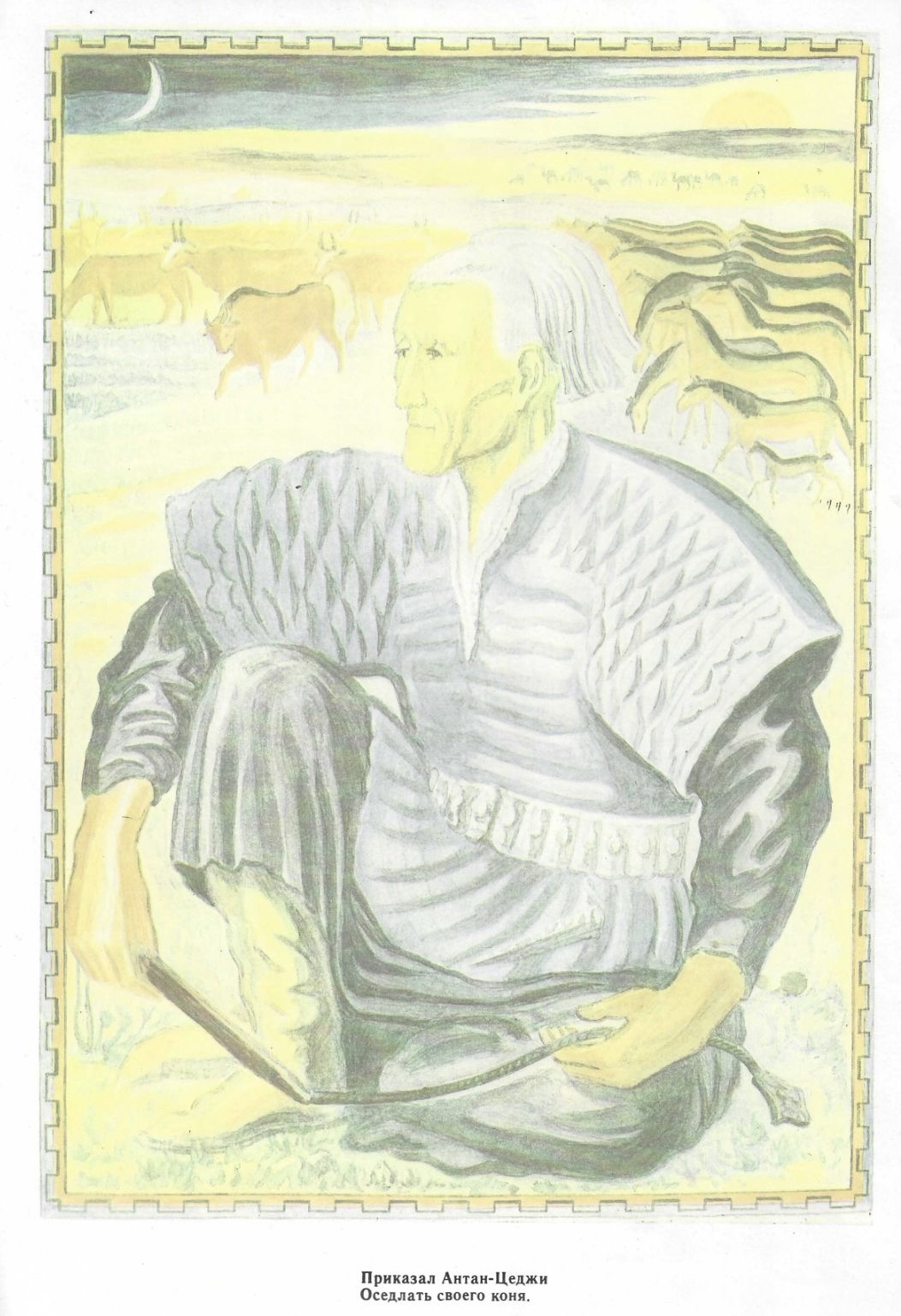
Altan Tseedga ("Golden Chest" or "Altan Čeji" in classical spelling) ranks among the most celebrated warriors in the Kalmyk-Oirat Epic of Jangar, revered for his extraordinary marksmanship, strategic brilliance, and unswerving loyalty to Jangar Khan.[1] As one of the twelve principal bogatyrs (heroes) in Jangar’s immortal retinue of 6,012 warriors, Altan Tseedga embodies the archetype of the peerless archer whose arrows never miss and whose foresight often turns the tide of battle in defense of the utopian realm of Bumba.
In the epic’s cantos, Altan Tseedga is depicted as a youthful hero possessing a golden breastplate that symbolizes both his invulnerability and his radiant valor. His signature weapon—a bow crafted from sacred materials and arrows fletched with eagle feathers—allows him to strike enemies from inconceivable distances, frequently annihilating entire armies with a single volley.[2] One of the most famous episodes dedicated to him, "The Campaign of Altan Tseedga against the Forty-Eight Khans," narrates his solo expedition to liberate captured comrades, culminating in the annihilation of forty-eight enemy rulers through precision archery that pierces multiple targets in succession.
Beyond martial prowess, Altan Tseedga serves crucial narrative functions. During feasts in Bumba’s grand palace, he often acts as scout and counselor, interpreting omens and devising strategies that complement the raw strength of warriors like Hongor or Sabar.[3] His marriage quest cantos follow the epic’s recurring pattern: abduction or voluntary union with a formidable heroine, reinforcing alliances and expanding Bumba’s influence. These episodes highlight themes of reciprocity between genders, where heroic brides match the bogatyrs in courage and wisdom.
Culturally, Altan Tseedga symbolizes intellectual warfare and long-range precision within the nomadic military tradition, reflecting the historical importance of mounted archery among Oirat-Kalmyk horsemen.[4] His character also carries spiritual resonance; invocations during performances by jangarchi singers frequently praise his “golden chest” as a metaphor for enlightened compassion tempered by lethal skill, aligning with Gelug Buddhist ideals adopted by the Oirats in the 17th century.
In modern Kalmykia and among Oirat communities in Mongolia and Xinjiang, Altan Tseedga remains an iconic figure in theater, literature, and visual arts. Statues in Elista, animated adaptations, and contemporary retellings—such as Saglar Boukeeva’s 2022 English translation—continue to celebrate his legacy, ensuring that his arrows still fly across generations as emblems of precision, loyalty, and the enduring defense of homeland.[5]